
 m. Сміла, Незалежності, 67г. оф, 406/6























DAHUA DH-IPC-HFW1431TC-A (4 MP) - PoE IP CAMERA



Description Dahua HFW1431TC-A
An Entry-series camera that still tells a person from a swaying branch
The 1xxx index in a Dahua part number marks the Entry line, the simplest range the manufacturer sells, and buyers normally expect nothing from it beyond an honest picture. The HFW1431TC-A is a conspicuous exception: its official specification lists Human Detection under Intelligence, meaning the camera classifies a moving target and separates people from everything else, and the alarm-event list carries a dedicated SMD (human) entry alongside ordinary motion detection. In daily use that changes everything about notifications — the phone stays quiet when a branch moves or a cat crosses the lawn, and buzzes when a human silhouette enters the frame, which is exactly the capability whose absence makes owners of cheap cameras switch push alerts off within a week and end up with a system that guards nothing. The limit deserves to be stated plainly: this is SMD-level classification with a single human category, not the full 2-series WizSense package with tripwire, perimeter protection and separate vehicle recognition, so a car is not identified as its own object type here. There is also a bonus for anyone building the whole system on Dahua: paired with a Smart NVR the camera supports Smart Search, letting you jump through recorded human events instead of scrubbing manually through hours of empty footage.
4 MP, a 92° field of view and the official DORI table
The 1/2.9" CMOS sensor outputs 2560×1440, roughly twice the pixel count of the familiar 1080p camera, and it delivers those full 4 MP at 25 or 30 frames per second with no trade-off in smoothness. The fixed 2.8 mm F2.0 lens covers 92° horizontally (50° vertical, 107° diagonal), noticeably tighter than the widespread 104-112° optics, and on a budget camera that is an advantage rather than a shortcoming: the same pixel budget is spread over a smaller area, so every object in the frame is rendered larger. Dahua publishes the DORI figures for this focal length as 66 m to detect that a person is present, 26.4 m to observe what they are doing, 13.2 m to recognise someone you already know and only 6.6 m to identify a stranger's face with evidential confidence. That last number answers the question everybody asks before buying: a gate, a doorway or a till has to sit closer than 6.6 m to the lens, while anything beyond twenty metres stays at the level of "somebody is walking toward the house" with no usable features. Close focus distance is 1 m, so the camera can be mounted directly above a door without losing sharpness, and if you need reach rather than width, the same model exists with a 3.6 mm lens: the angle narrows to 78° while DORI improves to 76/30.4/15.2/7.6 m.
Night vision: 30 m of infrared, Smart Illumination and no colour after dark
Darkness is handled by a single infrared LED rated for up to 30 m together with a mechanical ICR filter that swings aside in the evening and switches the camera to monochrome. Rated minimum illumination is 0.03 lux in colour and 0.003 lux in black and white at F2.0, and with the illuminator running the camera keeps working at zero lux, in complete absence of ambient light. Smart Illumination throttles the LED down as a subject comes closer, and this is not a cosmetic feature: without it a face two metres from the lens burns out into a flat white blob, while with it the features survive and remain comparable against a reference photo. The model's main limitation is also nocturnal — there is no white supplementary light, so everything recorded after sunset is monochrome: silhouette, height, gait and direction of travel, but never the colour of a jacket or a car body. If colour descriptions matter to you — and in a police report the difference between "a person was there" and "a person in a red jacket was there" is substantial — this catalogue has -IL models with warm white light; conversely, if the camera watches a walkway lit by a street lamp, it will produce a colour frame without any illuminator at all.
Image processing, codec and how much disk the archive eats
The 120 dB WDR here is a hardware mode rather than a digital imitation, and it earns its place exactly where one frame contains both a dark corridor and a brightly lit entrance: without it, a person standing against a doorway in daylight collapses into a featureless black silhouette. HLC suppresses glare from headlights and lamps, BLC compensates backlight, 3D noise reduction cleans the low-light picture and four privacy masks block windows you are not allowed to record — but note that image rotation is limited to 0°/180° on this model, with no 90°/270° corridor mode, which matters if you planned a vertical frame for a long narrow passage. H.265 with Smart H.265+ keeps the stream between 12 and 4096 kbps, and the camera serves two streams at once: the main 2560×1440 feed for recording and a sub-stream up to 704×576 for phone viewing over mobile data without pulling full resolution. For disk planning, the working figure is 3-4 Mbps for a 4 MP stream, roughly 30-40 GB per camera per day, so a 2 TB drive holds about two weeks of continuous footage from four such cameras and several times longer if recording is event-driven. The built-in microphone adds an audio track (G.711a, G.711Mu, G.726) and audio detection as a separate alarm trigger, though the legal side deserves a thought before installation rather than after a complaint: recording sound in spaces open to other people is regulated.
No memory-card slot: this camera only makes sense with a recorder
The Storage line of the official datasheet reads FTP and nothing else — there is no microSD slot in this variant, and that is the single most important architectural detail of the model, invisible in a feature list. The consequence is direct: whatever the camera sees has to leave over the network in the same second, to a recorder, a VMS server or an FTP target, and if the cable is cut or the recorder loses power, nothing is recorded at all, because there is no local buffer to back-fill from later. Interoperability is declared as ONVIF Profile S and Profile T plus CGI and P2P, so the camera registers properly in a Dahua recorder, in a third-party NVR and in PC-based video management software — precisely the point where no-name bargain cameras fail and end up discarded together with their brackets. The camera accepts up to six simultaneous users with 24 Mbps of total bandwidth: ample for a family checking the yard from their phones, but if ten people routinely open the stream, they should connect through the recorder rather than to the camera directly. Management runs through DMSS on mobile, Smart PSS Lite or DSS on a desktop and DoLynk Care for service diagnostics, yet none of those applications replaces a recorder as the place where the archive actually lives.
4.3 W of power draw, a metal housing 173 mm long and genuine IP67
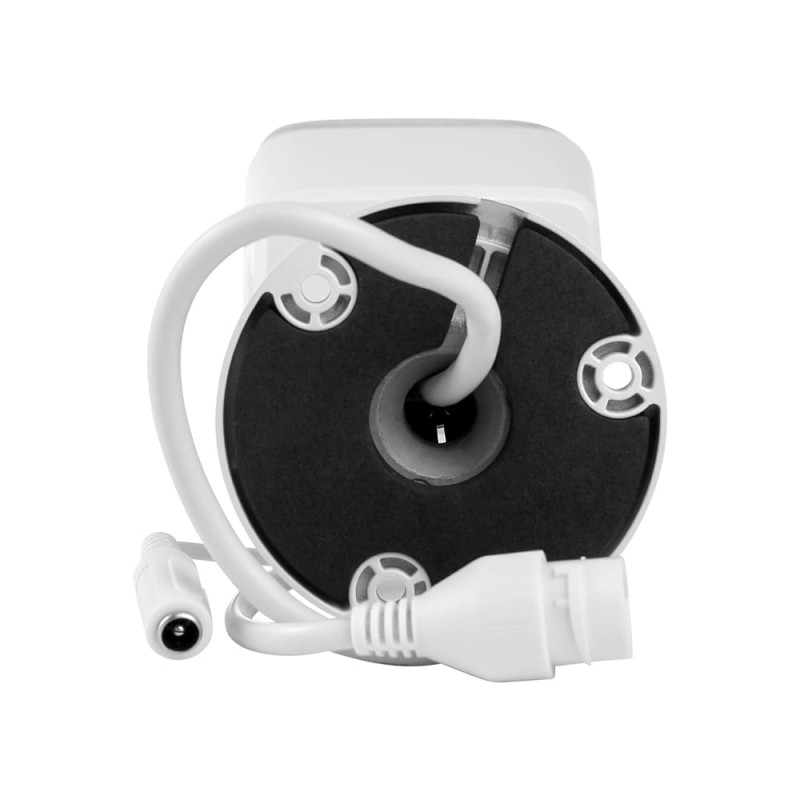
Power comes either from a 12 V DC adapter or over PoE 802.3af, and consumption is modest: 1.5 W baseline on DC and 1.9 W on PoE, rising to 3.5 W and 4.3 W respectively with the IR LED, WDR and intelligence all active. Those numbers make budgeting easy — eight of these cameras load a switch with roughly 35 W, so an ordinary eight-port PoE switch with a 60-65 W budget copes with headroom to spare and no separate injectors are needed. The datasheet lists the casing material as metal, which on a façade beats plastic in three practical ways: it does not chalk and fade after two summers, it draws heat away from the sensor in July, and it resists an attempt to break the housing by hand; the body is 173.3 mm long, 70 mm in diameter and weighs 0.44 kg, with the bracket integrated into the base so no wall reinforcement is required. IP67 means verified sealing after thirty minutes under a metre of water rather than a vague promise about rain, and combined with ±30% input-voltage tolerance and a -40 °C to +60 °C operating range it suits wet snow, voltage swings behind a generator and a cold start after a long outage. Dahua offers matching accessories for a tidy install — the PFA134 junction box, the sealed PFA130-E, the PFA151 corner bracket and the PFA152-E pole mount — while the warranty on this item is 12 months, typical for the 1-series, against the 24 months found on higher Dahua series in this same catalogue.
Where this camera belongs and what it is genuinely good at
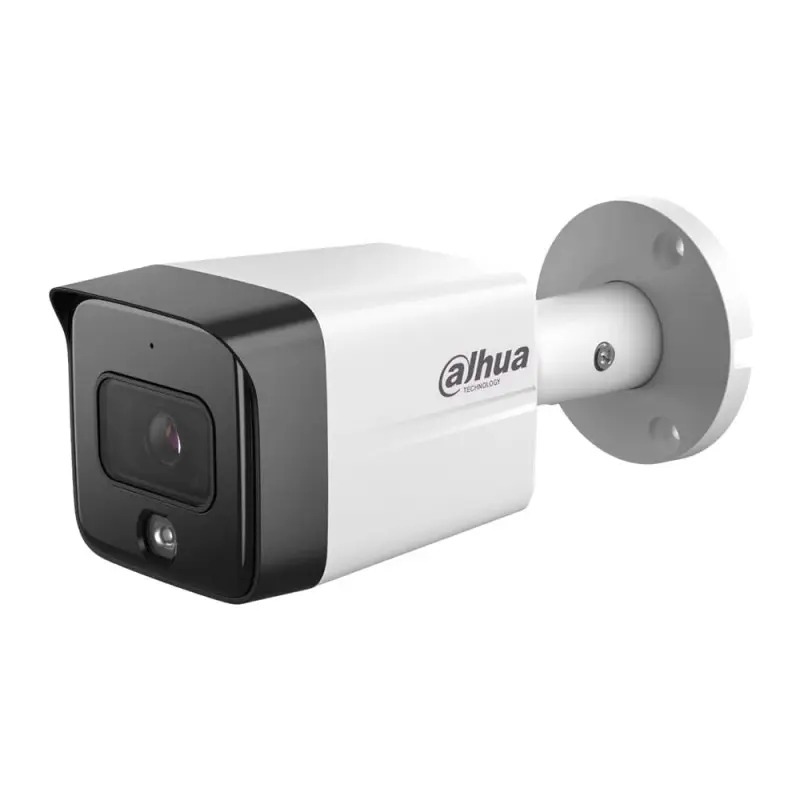
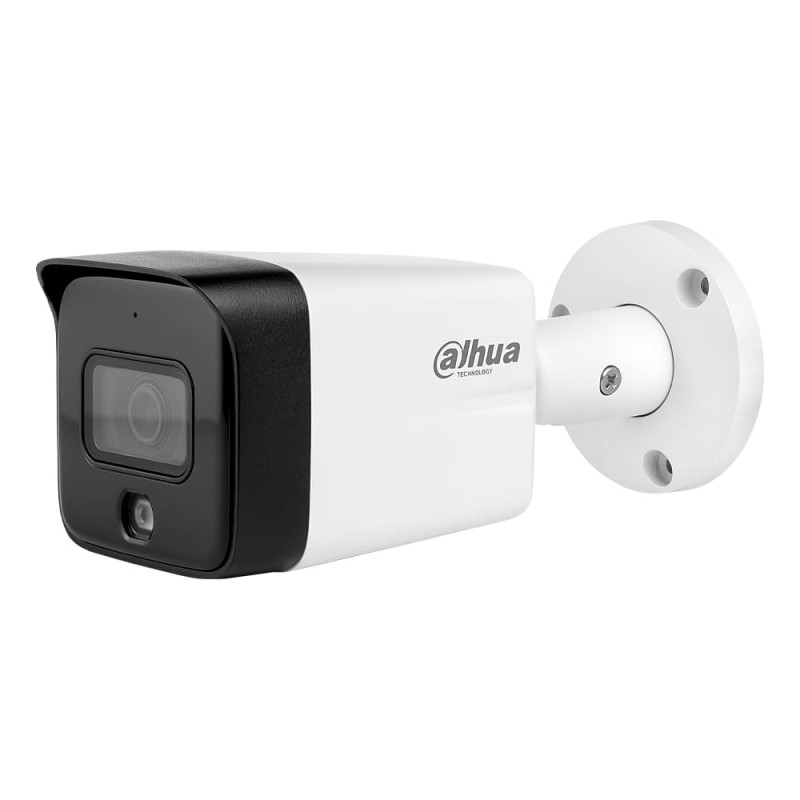
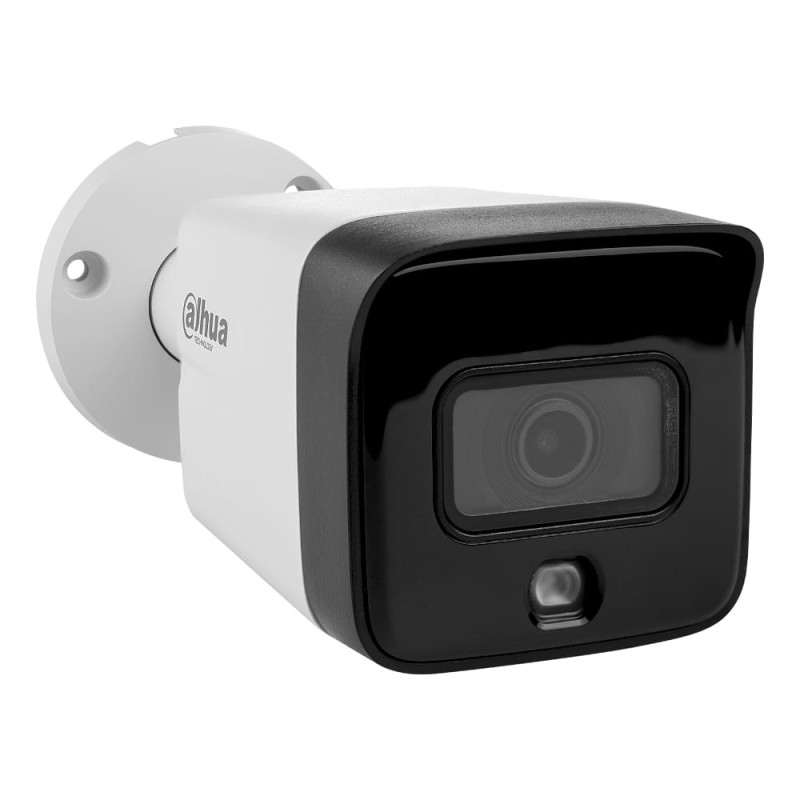
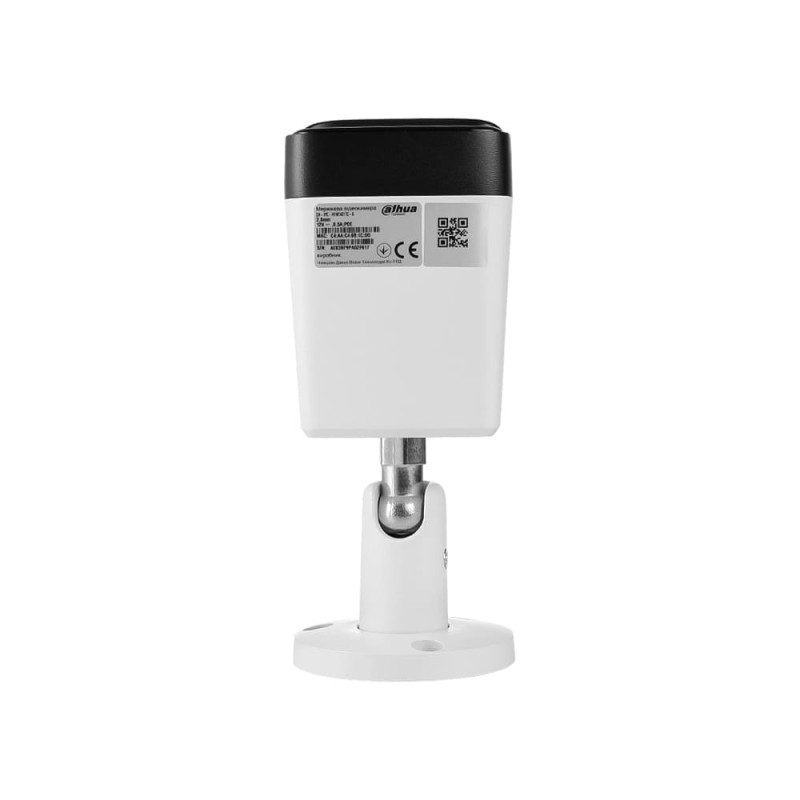
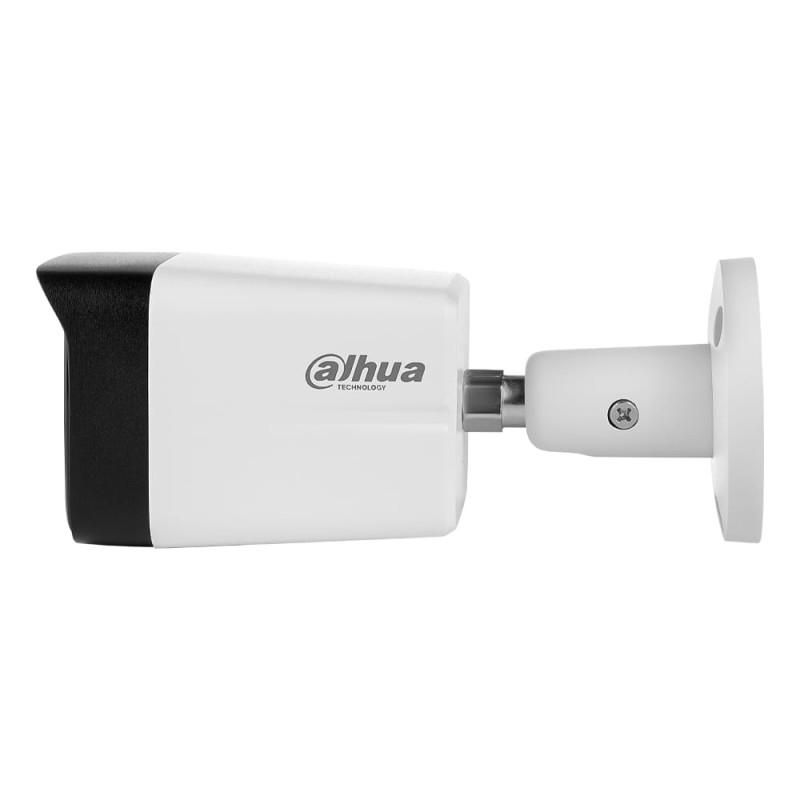
The bullet housing with its moulded sun shield is the classic choice for walls and façades: it is visible from a distance and deters a share of casual visitors on sight, while the shield keeps rain and low-angle sun out of the lens. A tighter-than-average 92° angle plus 66 m of detection range make this model accurate on elongated scenes — a passage between buildings, the driveway up to a house, a fence line running sideways, an entrance alley, a shop frontage with its pavement, a warehouse aisle — anywhere the question is who is moving along a line rather than what is happening across an open square. For a square courtyard, a sales floor or a living room the optics are already cramped: a 104-112° wide-angle model fits better there, otherwise the frame edges leave blind corners that a second camera has to cover. Nor should it be asked to identify a face beyond seven metres or read a licence plate on a moving car — the DORI table rules that out, and the fix is either moving the camera closer to the choke point, or the 3.6 mm variant, or a separate narrow-lens camera dedicated to the gate. One more practical boundary: with no SD slot this is a pointless purchase as a standalone "mount it and forget it" device — it only works as part of a kit with a recorder or a permanently available network storage target.
How it differs from the neighbouring Dahua models in this catalogue
Its closest relative is the Dahua DH-IPC-HFW1431S1 and its -BE variant from the same 1-series: identical 4 MP class, the same 30 m infrared reach, the same bullet form, but a 1/2.7" sensor with a wider 104° angle, full 2688×1520 only at 20 fps and, crucially, no object classification whatsoever — plain motion detection only. The choice between them is therefore about the task rather than the invoice: the 1431S1 sees wider and offers slightly more pixels on a static scene, while the 1431TC-A packs its pixels into a narrower sector, runs full 4 MP at 25-30 fps and filters alerts down to people. If you want the same electronics in a dome under an eave or on a ceiling, the catalogue has the HDW1431T1, and for places where someone may try to knock the camera aside there is the HDBW1431EP-S4 in a vandal-resistant dome. If 4 MP is more detail than the scene deserves, the junior HFW1230S1 at 2 MP sits nearby and genuinely suffices for a short three-to-five-metre passage, where paying extra for 4 MP will never show on screen. And when night colour matters, or you need vehicles filtered as well as people, look at the 2-series WizSense models — the HFW2449S-S-IL with combined infrared and white light, or the HFW2449TL-S-PRO with 50 m illumination: they cost more, but they cover exactly the scenarios in which the 1431TC-A deliberately concedes.
Tell us the distance to the point you need to cover and which recorder is already installed, and we will confirm whether this camera fits the task or whether the 3.6 mm version or a wide-angle model suits your geometry better.
Characteristics Dahua HFW1431TC-A
Reviews about Dahua HFW1431TC-A from real users
No reviews found







