
 m. Сміла, Незалежності, 67г. оф, 406/6























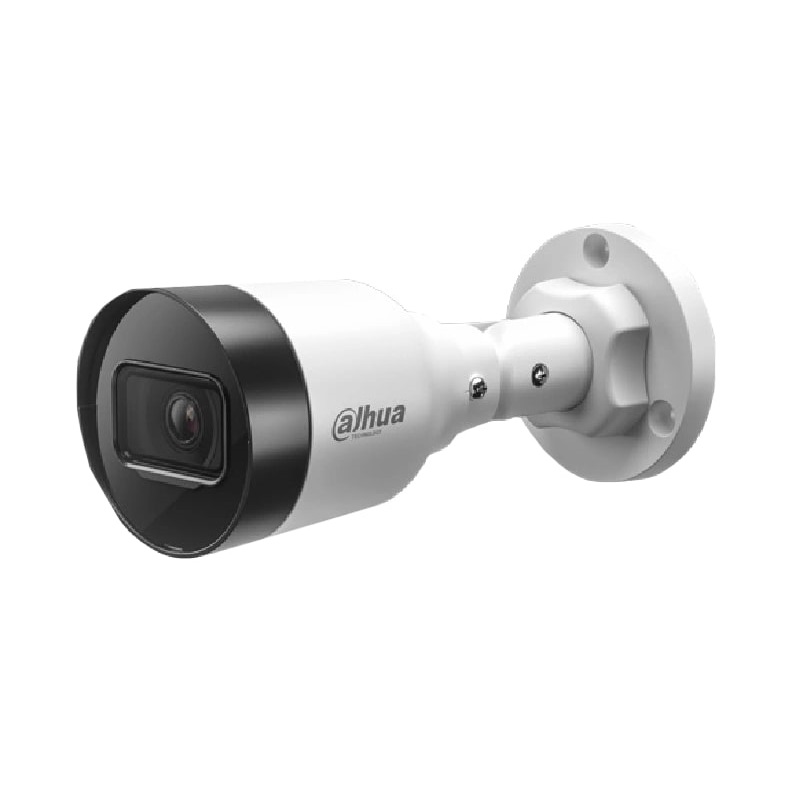
DAHUA DH-IPC-HFW1431S1 (4 MP/2.8 MM) - PoE IP CAMERA



Description Dahua HFW1431S1
Four megapixels in the simplest camera: what it buys you in the frame
The 1/2.7" sensor outputs a maximum of 2688×1520, which is twice the information per frame compared with the 2 MP cameras that still form the backbone of budget installations. In practice that doubling works less as "a nicer picture" and more as headroom for cropping: from the same wide view of a yard you can cut out the fragment with the person at the gate and still see a face rather than a mosaic of blocks. The 2.8 mm lens at F2.0 covers 104° horizontally and 124° diagonally, so the camera sees very wide and one unit is often enough to take in the yard, the driveway and the gate together. Official DORI distances for this optic are 56 metres to detect, 22.4 m to observe, 11.2 m to recognise and 5.6 m to identify a face — numbers worth checking against the real geometry of your site before buying. Note one technical trade-off: the full 4 MP frame of 2688×1520 is delivered at 20 fps, while smooth 25-30 fps require the 2560×1440 mode, so for a driveway with moving vehicles the second option is the sensible one even at the cost of a narrow strip of vertical coverage.
Night: a single IR LED rated to 30 metres with automatic intensity control
Illumination here is conventional infrared: one LED with a stated maximum reach of 30 metres, which is enough for a private yard, a driveway or the inner courtyard of a small site. Smart Illumination does the work of adjusting it — the camera lowers intensity for nearby subjects and raises it for distant ones, which cures the classic failure of cheap cameras where anyone stepping close to the lens turns into a white blob with no face. Colour sensitivity is 0.03 lux, so as long as a street lamp or a porch light is on the camera keeps colour; once the light is gone the IR engages and the image turns monochrome. This deserves to be said plainly: there is no white light in this model, so a night recording will not tell you the colour of a car or a jacket — you get a contrasty monochrome silhouette with a readable face within five or six metres. If colour at night matters to you — and for identification it changes a great deal — the catalogue's Dahua models with the -IL suffix and Full-color technology provide it; they cost more, and this is precisely the case where the surcharge changes the outcome rather than just a line in the specification.
What this camera does not have: AI analytics, and what that means day to day
This is the Entry series, and the most important thing about it is not what it includes but what it leaves out: there is no WizSense, no SMD Plus and no human-versus-vehicle classification. The camera relies on ordinary motion detection with four rectangular zones, which means it reacts to any change of pixels inside the selected area: a branch in the wind, the shadow of a passing car, a cat, rain inside the IR beam, a spider that has settled in front of the lens. The consequence is predictable and well known to installers: in the first week the owner reads every notification, in the second he scrolls past them, in the third he switches push off, and the camera turns from a security device into a pure archive device. That is exactly why this model makes sense where alerts were never part of the plan: recording runs to a recorder around the clock and the archive is reviewed after the fact, when something has happened and you need the time and the circumstances. There is audio detection and a tampering alarm for a covered lens as well, but these are supplementary events rather than a replacement for intelligent analytics.
Housing, weather and the realities of mounting a bullet camera
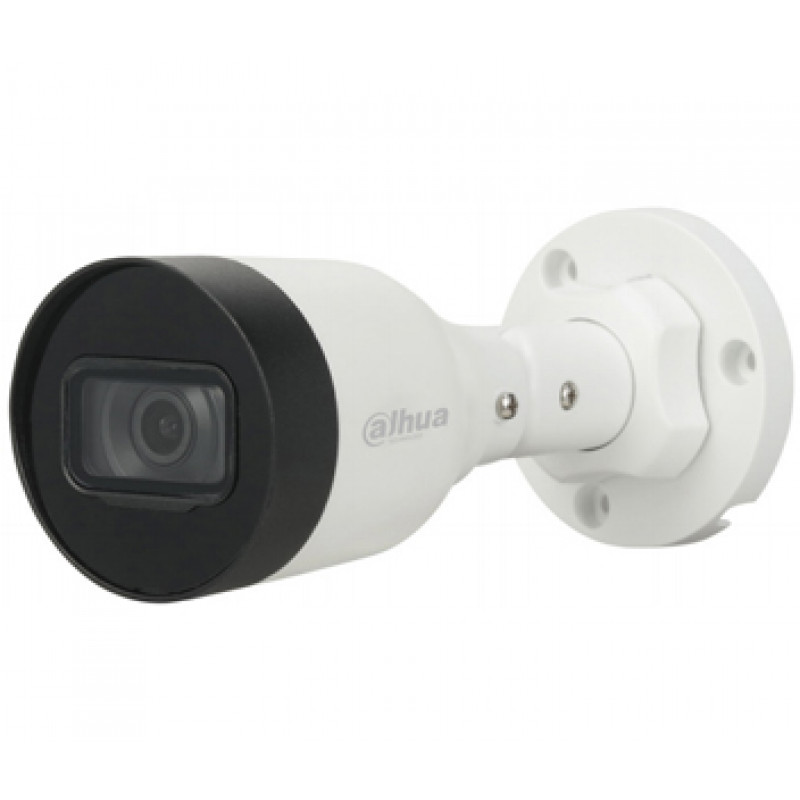
The housing combines metal and plastic and carries IP67: full dust protection and thirty minutes under a metre of water, which is ample for a façade, a soffit or a pole without any additional enclosure. The -40…+60 °C operating range is not marketing but Dahua's standard, and it is what separates a camera that boots after a winter blackout from cheap models rated from -10 °C that simply fail to initialise in January. A ±30% wide-voltage tolerance is included too, which is genuinely useful in residential areas with unstable mains and on long runs from a local power supply. The form factor is the classic bullet, 162.6 mm long and around 220 grams: it is clearly visible from a distance, and that works as passive deterrence, because most opportunistic intruders look for a property without obvious surveillance. The flip side of the same visibility is that a bullet on a bracket is easier to knock aside or twist by hand, so below two metres — in a stairwell or an archway — a vandal-resistant dome is more practical, and a bullet should be raised to 2.5-3 metres.
Power: PoE 802.3af or 12 V, and what it adds up to across a system
The camera accepts power two ways: locally from a 12 V supply or over twisted pair via PoE 802.3af — and the second is almost always the better choice, because one cable reaches the mounting point and backup power during outages only has to cover the switch. Consumption is tiny even by budget standards: about 1.9 W in basic mode on 12 V and up to 5 W at maximum over PoE with the IR illuminator running. For system design that means a lot of freedom: eight of these cameras amount to only about 40 W of load, so even the cheapest eight-port PoE switch with a 60 W budget covers the installation with headroom for cameras added later. The 100 Mbps network port carries two H.265 streams — a main one for recording and a sub-stream for viewing on a phone; the specified limit of six simultaneous users is a reminder that this is a camera meant to work through a recorder, not to be watched directly by a dozen people. If you power it from 12 V over more than twenty metres, plan on conductors of at least 0.75 mm², otherwise the voltage drop will cause reboots precisely when the illuminator kicks in.
Storage: there is no card slot, so a recorder is part of the kit
This is the point on which the model is most often bought by mistake: it has no microSD slot. The specification lists FTP as its only storage, meaning the camera either streams to a recorder or NAS, or uploads snapshots and clips to an FTP server — it keeps no local archive of its own. The conclusion is simple: this camera is bought together with a recorder, and if there is no recorder in the system it is the wrong camera for you — look at models with a card slot instead. For disk sizing: 4 MP in H.265 at moderate settings averages 3-4 Mbps, roughly 35-43 GB per day from one camera recording continuously, so a 2 TB disk holds about forty-five days for a single camera or a little over a week for four. The camera supports ONVIF profiles S and T plus CGI, P2P and Genetec, so it integrates both with the Dahua recorders in this catalogue — the DHI-NVR1104HS-P-S3/H or DHI-NVR2108-8P-I2 with built-in PoE — and with third-party NVRs.
Where this camera belongs and the jobs it was designed for
This is a workhorse overview camera for straightforward tasks: the perimeter of a house, a driveway, a shop entrance, a warehouse yard, a corridor or a workshop where what matters is having the recording rather than clever alerts. The 104° angle works well wherever one camera has to cover an area without leaving a blind spot against the wall — on the corner of a building, for instance, from which both the façade and the path to the gate are visible. Going by the DORI figures, the point where a face must be identifiable — a gate, a door, a till — needs to sit within five or six metres of the camera; anything beyond twenty to twenty-five metres will be recorded as the presence of a person without distinguishing features. Where it definitely does not belong is anywhere licence plates must be read at an entrance: that calls for tighter or varifocal optics, and the wide 2.8 mm angle fundamentally cannot help. The second case for choosing something else is a site with no permanent operator where everything rests on notifications: without AI filtering this model will flood the phone with false alarms and the system will not perform a security role at all.
How it differs from the neighbouring models in this catalogue
The catalogue also lists the DH-IPC-HFW1431S1-BE with identical specifications — it is the same camera in a different supply variant, so choose by availability, because there is no difference in the image. One step up is the DH-IPC-HFW1431TC-A: the same class and the same 4 MP, but with a built-in microphone as a standard function if audio recording matters to you. The meaningful jump comes with the move to the 2xxx series: the DH-IPC-HFW2449S-S-IL is also 4 MP and also a bullet, but with WizSense, SMD Plus and dual illumination — colour at night and alerts only for people or vehicles; if you intend to react to alarms rather than merely keep an archive, that upgrade is fully justified. For longer distances there is the DH-IPC-HFW2449TL-S-PRO with fifty-metre illumination, and if the task is reading plates at a gate, the catalogue offers the varifocal DH-IPC-HFW1230T1-ZS-S5 (2 MP, 2.8-12 mm): lower resolution, but the ability to zoom onto exactly the strip you care about. And an honest recommendation in the other direction: if you only need to see that someone walked through a utility room or under a canopy, the catalogue's junior 2 MP DH-IPC-HFW1230S1 is cheaper, and 4 MP would give you nothing in that scenario.
Tell us what exactly you need to see in the frame and at what distance — we will say whether this model is enough and, if needed, put together a kit with a recorder and a disk sized for the archive depth you want.
Characteristics Dahua HFW1431S1
Reviews about Dahua HFW1431S1 from real users
No reviews found







