
 m. Сміла, Незалежності, 67г. оф, 406/6























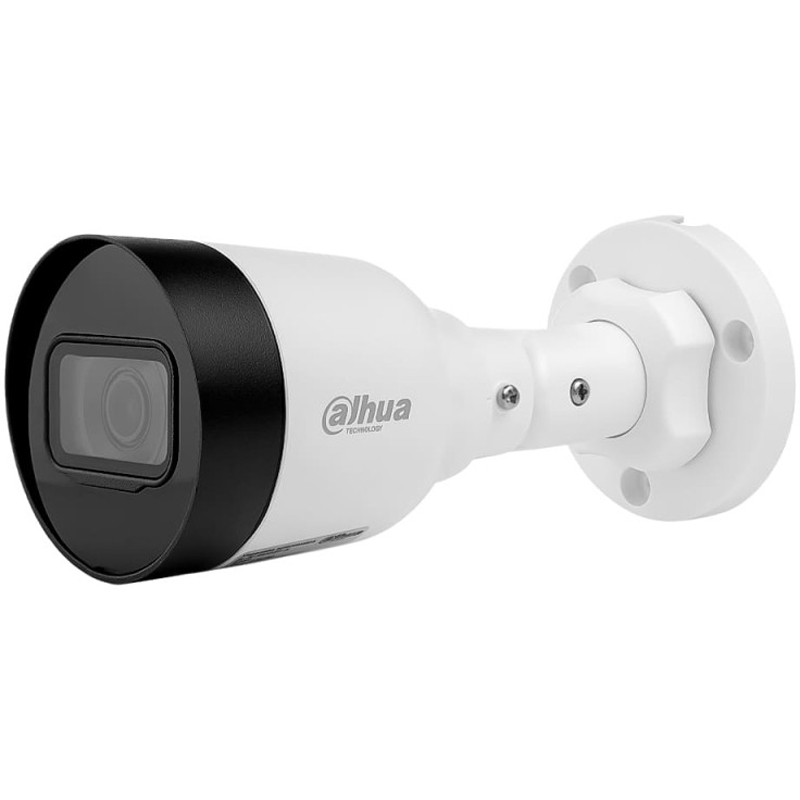
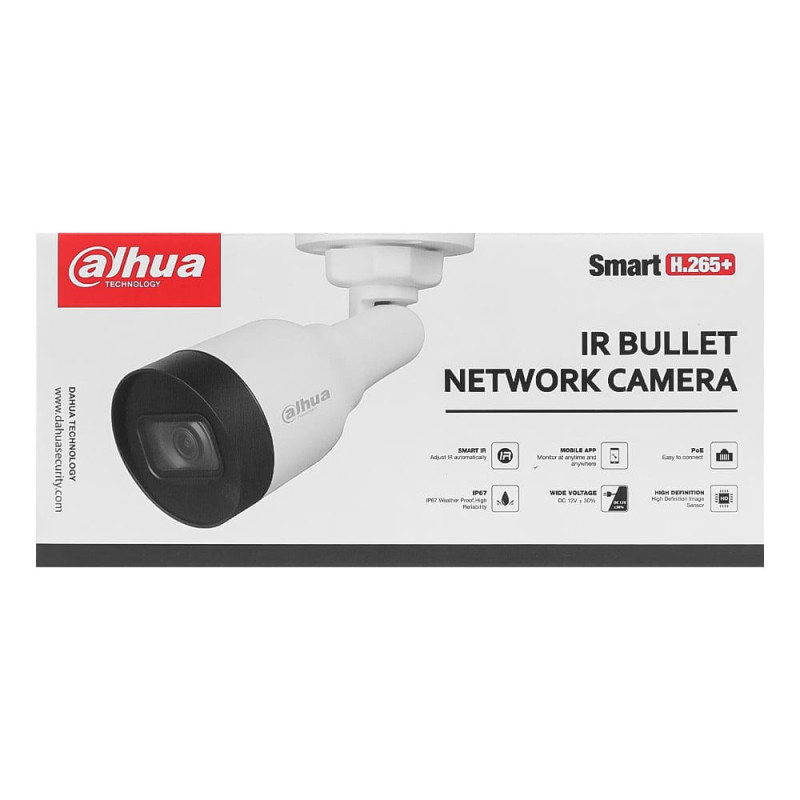
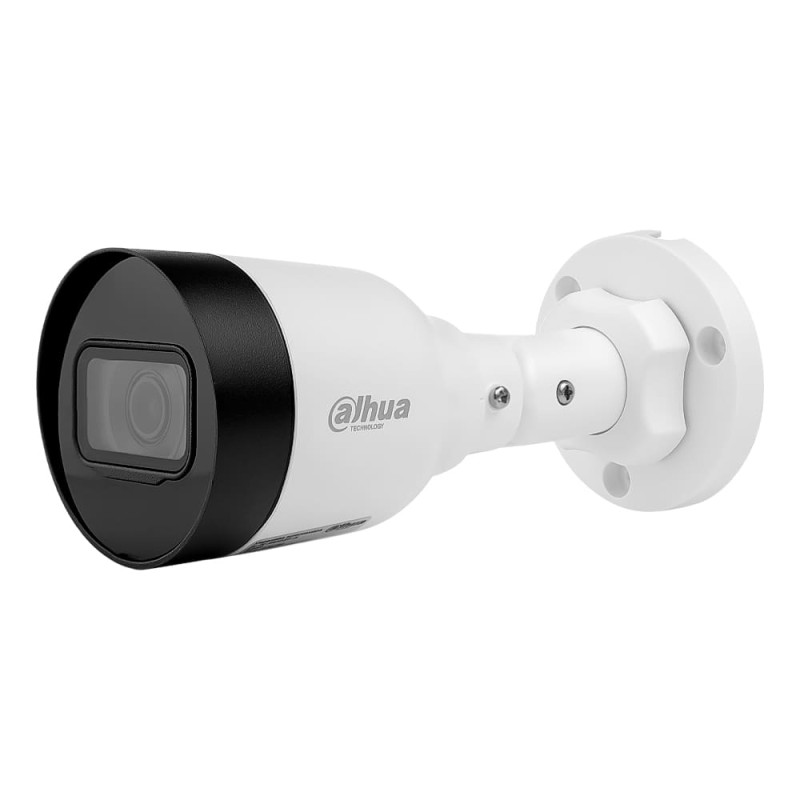
DAHUA DH-IPC-HFW1230S1 (2 MP/2.8 MM) - PoE IP CAMERA



Description Dahua HFW1230S1
Dahua Entry series: what the low price buys and what it gives up
The 1xxx index in a Dahua model name marks the Entry line, designed for small sites — an apartment, a summer house, a corner shop, a two-room office — where the point is to have video evidence at all rather than business-centre analytics. The HFW1230S1 is built around a 1/2.8" sensor delivering 1920×1080 at 25 frames per second, and it sits below any 2-series or 3-series camera mainly because three things are absent: an AI co-processor, a memory-card slot and white supplementary light. What is present is the full set of basic image hygiene: H.265 with Smart H.265+, DWDR, 3D noise reduction, HLC and BLC, four privacy masks and 90/180/270° image rotation for narrow corridors. Interoperability is declared as ONVIF Profile S and Profile T, so the camera registers correctly in a Dahua recorder, in a third-party NVR and in a PC-based VMS — precisely the property that no-name budget cameras usually fail, which is why they end up in the bin. If, on the other hand, you expect the camera itself to tell a person from a swaying branch, or to record without a recorder, this is the wrong model and you should look straight at the 2-series WizSense range.
2 MP and a 2.8 mm lens: what is actually legible on screen
Two megapixels of 1920×1080 is exactly the resolution Dahua uses for the official DORI table, and the four numbers are worth reading carefully: detection of a human presence out to 38.6 m, observation of what that person is doing to 15.4 m, recognition of someone you already know to 7.7 m, and identification of a stranger's face with evidential confidence only to 3.9 m. That table settles the usual question about licence plates in one line — a car stopping six to eight metres from the lens will have a readable plate, a car twenty metres away will not, and no amount of configuration changes it. The 2.8 mm optic gives a 102° horizontal field of view (54° vertical, 120° diagonal), which covers the whole façade of a small house or an entire inner courtyard, so one camera genuinely replaces two narrow-angle units. Close focus distance is 0.5 m, meaning the camera can be mounted almost against a wall or directly above a doorway and still hold focus — in tight indoor spaces that matters more than extra megapixels. The same model is also offered with a 3.6 mm lens: the angle narrows to 84°, but DORI improves to 49.7/19.9/9.9/5.0 m, so if the task is watching one distant point rather than a whole yard, specify that focal length when ordering.
After dark: a single 30 m infrared illuminator plus Smart IR
Night operation relies on one IR LED rated for 30 m and a mechanical ICR filter that swings aside at dusk and switches the picture to black and white; minimum illumination is quoted as 0.01 lux at f/2.0. Night footage from this camera is monochrome by design — there is no white light here, so you will never recover the colour of a jacket or a car body from a night clip, only a silhouette, a height, a gait and a direction of travel. Smart Illumination throttles the LED down for nearby subjects, and that is not cosmetic: without it the face of someone standing two metres from the lens burns out into a white blob, while with it the same face stays readable. The 30 m figure also deserves an honest reading — it is the distance at which the camera can tell that something is moving, not the distance at which you can tell who it is, so at the far edge of the beam you get movement and nothing more. Where colour at night genuinely matters, for instance when you may have to describe a vehicle that entered the yard, this catalogue carries -IL models with warm white light, and saving money on the Entry series costs you exactly the identifying details people later come asking for.
Motion detection only: the limitation to understand first
The complete list of events this camera can raise on its own, straight from the specification, is motion detection in four rectangular zones, video tampering, network disconnection, IP conflict, illegal access and a security exception. There is no object classification whatsoever — neither SMD Plus nor the human and vehicle recognition that the 2-series WizSense cameras carry — and that is the single most important difference to grasp before buying rather than afterwards. The consequence is entirely predictable: pointed at a yard with trees, the camera will alarm on every branch in the wind, on the cat, on cloud shadow and on the headlights of a car passing in the street, and within a week the owner silences notifications altogether, at which point the system stops being a security system. The gap can be closed without replacing the camera: send the stream to a Dahua recorder with an I or I2 index, or to any NVR that runs analytics on the recording side, and human/vehicle classification happens there while the camera stays a plain pair of eyes. This is why the HFW1230S1 makes sense bought together with an intelligent recorder rather than as a standalone device expected to deliver filtered alerts to a phone.
Storage: no memory card, so the recorder is not optional
The Storage line of the official specification lists FTP and nothing else — this variant has no microSD slot, so everything the camera sees has to travel over the network at the moment of recording. The practical consequence matters more than it sounds: if the cable is cut or the recorder loses power, nothing is recorded at all, because there is no local buffer to pull the missing footage from afterwards. H.265 with Smart H.265+ keeps the stream between 12 and 6400 kbps, and at the two to three Mbps typical for 1080p a single camera consumes roughly 25–30 GB per day, which means four of them record continuously for about two to three weeks on a 2 TB disk. Two simultaneous streams are available: the main 1080p feed for recording and a sub stream up to 704×576 that is the sensible one to watch on a phone over mobile data instead of dragging the full feed across the network. Interoperability covers ONVIF Profile S and Profile T plus CGI, P2P and Genetec, so there is no lock-in to one brand — the camera behaves properly inside somebody else's system, and the DMSS app is only needed when the whole installation is built on Dahua hardware.
Power, housing and mounting: 162 mm, 220 grams, IP67
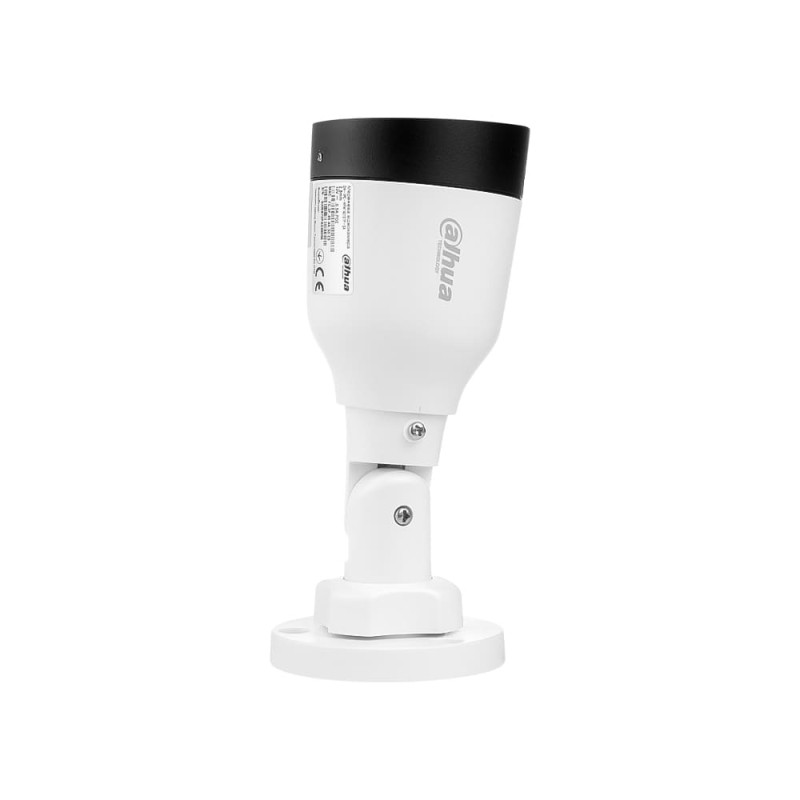
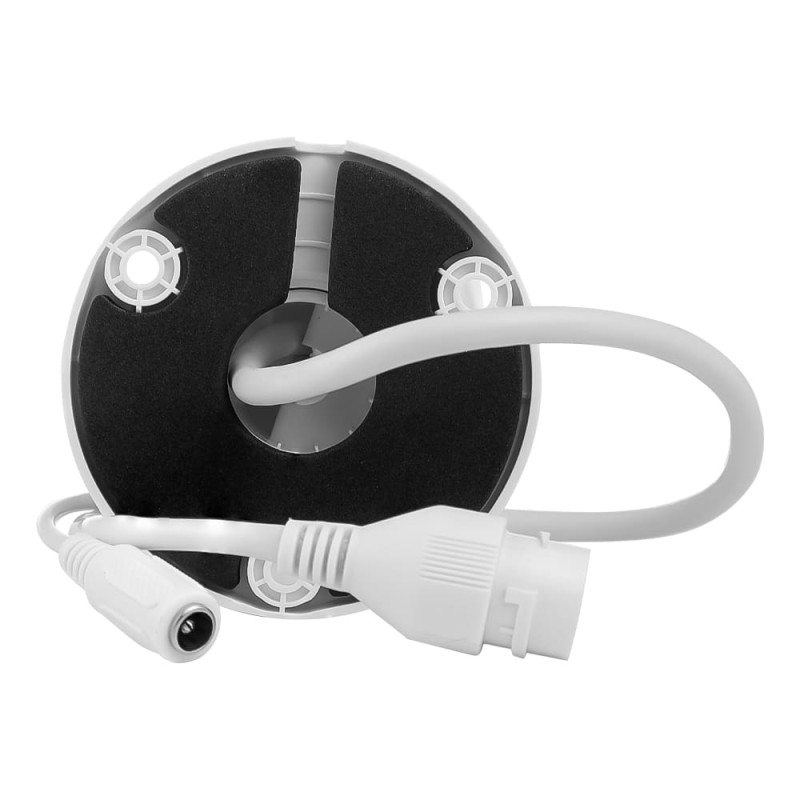
The camera runs from either 12 V DC or PoE 802.3af and draws very little: 1.4 W from an adapter and 2.2 W over PoE in basic operation, rising to 3.3 W and 4.3 W respectively at maximum with the IR LED, filter switching and encoder all working. Those are comfortable numbers for sizing a system — eight of these cameras on one switch add up to around 35 W, so an inexpensive eight-port PoE switch with a 60–65 W budget carries them with room to spare and no separate injectors are needed. The metal-and-plastic body measures 162.6 mm long by 70 mm in diameter and weighs just 220 g, the bracket is part of the base so no wall reinforcement is required, and the PFA134 junction box is available when the cable has to enter the wall neatly. IP67 is not merely resistance to rain but verified sealing after thirty minutes under a metre of water; combined with a ±30% input voltage tolerance and a -40 °C to +60 °C operating range, it suits wet snow, generator-induced voltage swings and a real Ukrainian winter. Warranty on this item is 12 months, which is normal for the Entry series — higher Dahua lines in this same catalogue come with 24 months, and for a camera destined for a pole or a roof edge that difference is worth weighing.
Where this camera belongs and which jobs it really does
A bullet housing with its own sun shield is the classic choice for walls and façades: it is visible from a distance, which deters a share of casual visitors by itself, and the shield keeps rain and low sun off the lens. The scenarios this model fits best are a building entrance or lobby, a shop door viewed from inside, a warehouse aisle, a passage between buildings, a small courtyard or a two-to-three-car parking spot under the windows — anywhere the subject is three to ten metres away and you need a clear general picture rather than portrait detail. The wide 102° view and modest 2 MP make it the wrong tool for gate control with plate reading at a distance, for a long fence or a driveway beyond thirty metres, and for a retail floor where you must see which item came off the shelf. Nor should it be the only camera on a site that must be described in colour at night: a monochrome IR frame records the fact but not the features, and in a conversation with the police that is the difference between "a person was there" and "a person in a red jacket was there". As a general-view workhorse in a four-to-eight-camera set, where two or three positions cover the overview and the critical points go to higher models, it does its share of the job without overpaying.
How it compares with its Dahua neighbours in this catalogue
Its closest relative is the Dahua DH-IPC-HFW1431S1 at 4 MP: the same 162.6 mm body, the same 30 m infrared reach and the same AI-free Entry series, but twice the pixels, a genuine 120 dB WDR instead of digital DWDR and a built-in microphone, with DORI rising from 38.6/15.4/7.7/3.9 to 56/22.4/11.2/5.6 m — so paying up for 4 MP buys recognition distance specifically. If you want the same electronics in an eyeball dome that tucks under an eave, the catalogue has the HDW1230T1, a 2 MP unit from the same family; if the site is long and you need reach, the HFW1230T1-ZS-S5 adds a motorised 2.8–12 mm lens and 50 m of IR, letting you set the angle after installation. A different class altogether is the HFW2249S-S-IL: still 2 MP, but 2-series WizSense with SMD Plus, human and vehicle recognition and dual IR plus warm white illumination, meaning colour at night and filtered alerts. The honest advice: if you already own a recorder that does the analytics and the camera is watching a short passage, the HFW1230S1 is enough and the extra megapixels would never be visible. If this is the first camera on the site, colour at night matters and you want alerts only for people, buy into the 2-series and keep this model for the secondary angles where the fact of recording is all you need.
Tell us which recorder is already installed and how far the subject will be, and we will check whether this model covers the job or whether a 4 MP version or one with white light suits it better.
Characteristics Dahua HFW1230S1
Reviews about Dahua HFW1230S1 from real users
No reviews found







