
 m. Сміла, Незалежності, 67г. оф, 406/6























DAHUA DH-IPC-HDW2449TM-S-IL (4 MP/2.8 MM) - DOME PoE IP CAMERA

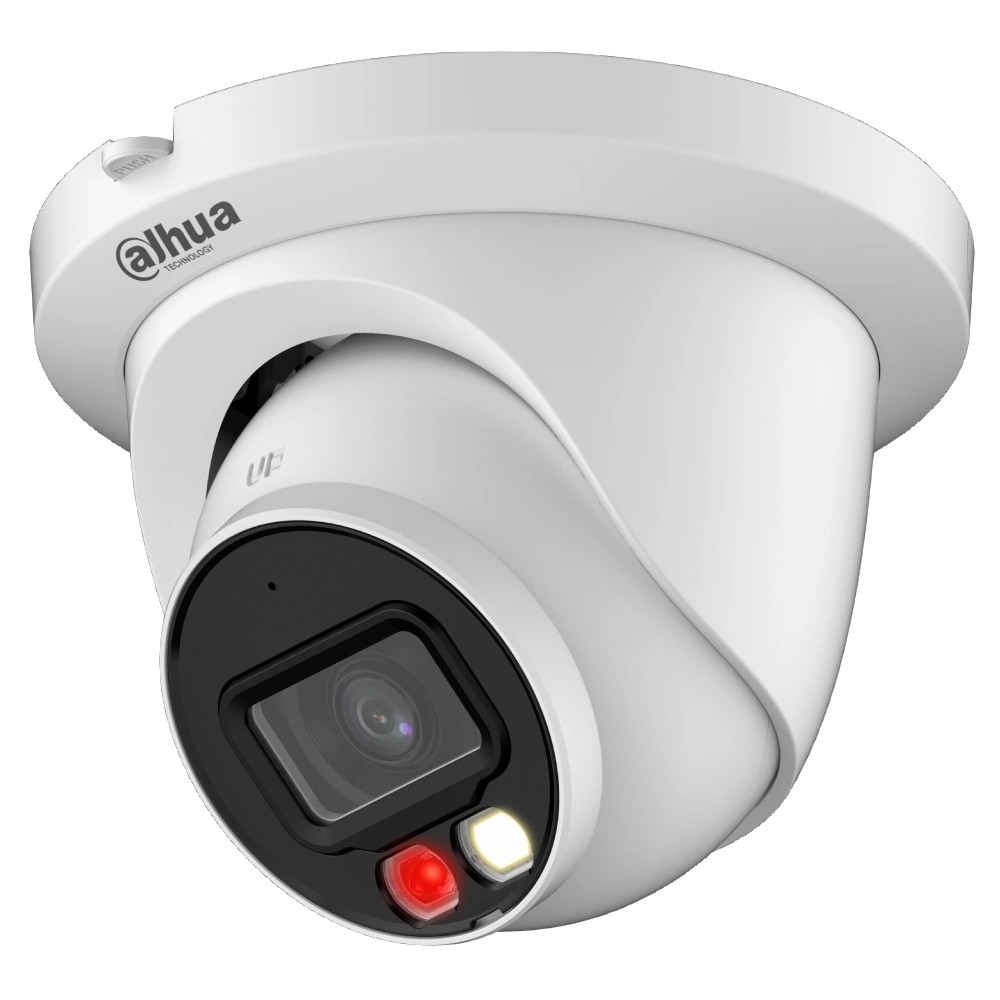
Description Dahua HDW2449TM-S-IL
Smart Dual Light: colour footage at night instead of a grey silhouette
The -IL suffix stands for Smart Dual Light, and it means the camera carries two separate illuminators: one infrared LED reaching up to 30 metres and one warm white LED with the same range. By default the night mode uses infrared only, so the camera records in black and white while staying invisible — nobody is dazzled and no light pollution spills across the property. The moment the on-board analytics decides that a person or a vehicle has entered the scene, the warm white light switches on and the event itself is recorded in full colour, with a colour snapshot attached to the alarm log. The gap between those two modes is entirely practical: a monochrome frame shows you "a man in a light jacket", a colour frame shows "a man in a red jacket next to a grey estate car", and that is the level of detail a police report or an insurance claim actually needs. Minimum illumination of 0.006 lux in colour and 0.0006 lux in black and white means the sensor keeps pulling detail out of a street lamp or a lit window long before the illuminator is needed, and with the LEDs on it works in total darkness at 0 lux. One limitation is worth knowing up front: warm white light is visible at night, so under a bedroom window or in a stairwell where residents dislike sudden flashes, installers either disable the feature or choose a plain infrared model instead.
4 MP on a 1/2.9-inch sensor: what the frame really shows
The 1/2.9" sensor tops out at 2688 × 1520 pixels, and there is a detail shops rarely mention: at full 4 MP the camera delivers up to 20 frames per second, while the familiar 25 or 30 fps are available at 2560 × 1440. For a general view of a yard or a façade the difference between 20 and 25 fps is invisible, but if you need to read fast movement — a hand reaching into a pocket, a car passing close to the lens — it is better to switch to 2560 × 1440 and get the smoother stream. The official DORI figures for the 2.8 mm lens are detection at 63.6 m, observation at 25.4 m, recognition at 12.7 m and identification of a specific person at 6.4 m. Translated into a real garden: you will see movement along the far fence, but you will only identify a face where the person comes closer than six or seven metres, which is why gates and front doors should be framed as close to the camera as the layout allows. The lens is fast at F1.6 and covers 95° horizontally and 114° diagonally, so a single unit takes in a typical private yard or an entrance driveway in one shot. A wide angle is always a trade-off: 2.8 mm is excellent for the overall picture but will not let you read a number plate at twenty metres, and that job needs a second camera with a narrower or varifocal lens.
WizSense and SMD Plus: alerts about people, not about branches
This is a WizSense 2 Series camera, which means a dedicated deep-learning chip inside the housing, so an object is classified before the event ever becomes a notification. SMD Plus sorts everything that moves pixels in the frame and discards what you do not care about — a branch in the wind, a cloud shadow, a cat on the path, raindrops lit up by the illuminator. On top of that sits perimeter protection with tripwire and intrusion rules, both supporting accurate human and vehicle classification, so the camera can be told to react to a person on the lawn while ignoring a car on the driveway. The value of that filtering is mundane but decisive: a camera without analytics pings you on every pixel change, the owner mutes the alerts within a week, and the system quietly degrades into an archive nobody ever opens. To be fair about the limits, this is mid-tier analytics — it reliably separates people from vehicles and drives the white light, but there is no face recognition, no people counting and no plate reading here; those live in the 3 and Pro series. Paired with a Dahua recorder that supports Smart Search, the same metadata lets you ask the archive for "people only, last night" instead of scrubbing through eight hours of footage.
Where this camera belongs and what it is built for
The eye-ball body is a hemisphere on a ball joint inside the base: you aim it after mounting, and afterwards nobody can twist it by hand, because there is no long arm and no movable bracket to grab. Natural positions for this model are the eaves or soffit of a house, the ceiling of an open garage or carport, an entrance gate area, the façade of a small shop, an office entrance lobby — anywhere you need a wide view and want colour rather than a bare motion record at night. The 95° horizontal field covers the apron in front of a house or a parking bay for several cars, and the 0.9 m close-focus distance lets you mount the camera directly above a door and still see whoever is standing right against it. Where it does not belong: on a driveway where plates must be read at twenty or thirty metres; in a stairwell or shop floor where the camera may be struck, since a vandal-resistant dome is the right answer there; and in rooms where warm white light would shine into someone's window at night. On a long, narrow site — a fence line or a driveway — two of these facing each other beat a single unit in the corner, because a subject is framed from both sides regardless of which way they walk. Indoors the model works too, but 30 metres of illumination in a corridor is overkill, and a cheaper camera with a 10-15 m illuminator does the same job.
Power, housing and mounting: what to budget for
The camera runs either on 12 V DC or on PoE to the 802.3af standard, meaning a single twisted-pair run with no mains socket needed at the mounting point. Consumption is modest: 2.5 W in the basic PoE mode and up to 5.2 W at peak, when H.265, analytics, WDR and the warm light all work at once; eight such cameras add up to roughly 42 W, so a switch with a 60-65 W PoE budget is comfortable and the more expensive 802.3at class is unnecessary. The manufacturer explicitly quotes a ±30 % input voltage tolerance, which matters in rural and suburban grids with habitual sags, and also on long 12 V runs where the cable itself eats voltage. IP67 is not only about dust: the enclosure survives half an hour under a metre of water, so the camera can sit on an exposed façade with no eave above it, while the -40 °C to +60 °C range covers any winter with margin. The housing combines a metal core and metal cover with a plastic decorative ring, measures 99.1 mm high by 121.9 mm across and weighs 460 g, so no reinforcement of the mounting surface is required. For a tidy installation, budget the PFA130-E junction box from the start to hide the splice and the slack cable, and add a PFA152-E pole bracket or a PFB205W-E wall arm where the surface is awkward.
Storage: the memory card, two streams and real recording depth
The camera takes a microSD card of up to 256 GB and can also push video and snapshots to FTP or encrypted SFTP, and neither path depends on a recorder being alive. Here is the depth in real numbers: at roughly 4 Mbps a day of 4 MP footage occupies about 43 GB, so a 256 GB card holds close to six days of continuous recording. Enable Smart H.265+, which drops the bitrate on a static scene to around 2 Mbps, and the same card covers eleven to twelve days; switch to event-based recording and it stretches to several weeks. Two streams run in parallel: the 4 MP main stream for the archive and a 704 × 576 sub stream for phone viewing over mobile data, which is precisely why the app opens quickly on a weak connection. The network port is 10/100 Mbps and up to six users may connect at once within a combined 36 Mbps, which is ample for a home or a small site, though streaming the main channel to five devices simultaneously is asking for trouble. Be clear about what the card is for: it is insurance against a network outage or against thieves walking off with the recorder and everything on it — not a replacement for an NVR, because the card leaves with the camera if no second unit covers it.
How it compares with its neighbours in this catalogue
Its closest relative here is the Dahua DH-IPC-HDW2449T-S-IL: same sensor, same dual illuminator, same analytics, but a smaller shell at 101 mm across and 370 g against 121.9 mm and 460 g — if the camera has to fit a narrow soffit, or you simply do not want a conspicuous hemisphere on the façade, take the smaller one, while this version wins on a broader base that swallows cable slack and on Milestone appearing in its compatibility list. The Dahua DH-IPC-HDW2849TM-S-IL is the same body and the same logic at 8 MP: paying extra makes sense on a wide scene you intend to zoom into afterwards, whereas in a tight yard 4 MP gives practically the same result with a lighter load on storage. The Dahua DH-IPC-HDW2249T-S-IL is the 2 MP sibling with lower draw — worth taking where only the fact of an event matters (a gate, a porch, a side door) rather than the detail. If the camera can be hit or torn off — a stairwell, a workshop, a shop floor — the vandal-resistant DH-IPC-HDBW2449E-S-IL dome is the sounder choice, and when a microphone and alarm inputs for a siren are also needed, the DH-IPC-HDBW2449F-AS-IL covers that. The DH-IPC-HDW1431T1 is a markedly cheaper 4 MP option, but it belongs to the first series: no AI classification and no white light, meaning alerts on any motion and a monochrome night. Finally the DH-IPC-HFW2449S-S-IL is effectively the same electronics in a cylindrical metal body — choose it when the camera hangs on a wall under a canopy and should be demonstratively visible, and choose this eye-ball when it is better tucked into the architecture under the eaves.
If you are unsure how many cameras and which lenses your site actually needs, send us a plan with dimensions and entry points and we will show what each camera would frame and where a second unit earns its place.
Characteristics Dahua HDW2449TM-S-IL
Reviews about Dahua HDW2449TM-S-IL from real users
No reviews found







