
 m. Сміла, Незалежності, 67г. оф, 406/6























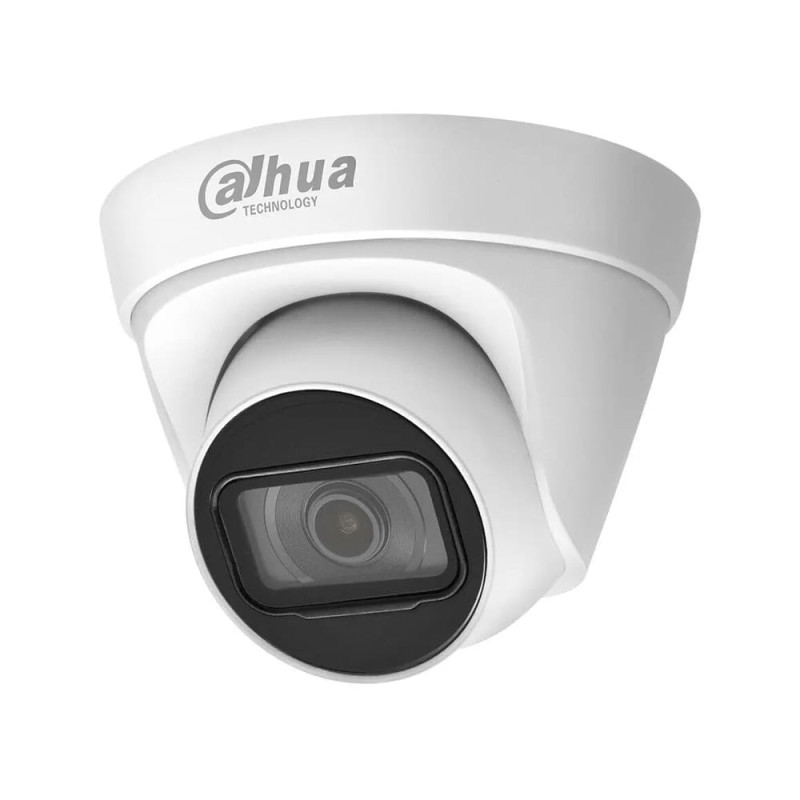
DAHUA DH-IPC-HDW1230T1 (2 MP/2.8 MM) - DOME PoE IP CAMERA



Description Dahua HDW1230T1
2 megapixels, a 102° angle and honest distances: what you will actually see
The 1/2.8-inch sensor delivers 1920×1080 at 25 frames per second — plain Full HD, enough to understand what is happening on the property, yet not always enough to identify a stranger from the recording afterwards. The 2.8 mm lens covers roughly 102° horizontally and about 120° diagonally, so a single unit takes in an ordinary yard, a porch or a small sales floor without blind corners at the edges. Dahua's published DORI figures for this optic are worth knowing before you mount anything: detection of a person at 38.6 metres, observation of what that person is doing at 15.4 metres, recognition of someone you already know at 7.7 metres, and reliable identification of an unfamiliar face only at 3.9 metres. That last number is the one that drives the installation plan — a gate, a front door or a till area has to sit within about four metres of the lens if faces matter, instead of hoping to zoom in later. The digital zoom on board is not optical magnification; it simply stretches the same pixels, so enlarging a figure captured twenty metres away produces a blur no matter how the stream is configured.
Night vision: a single 30-metre infrared emitter and a black-and-white picture
Illumination comes from one high-output infrared LED rated for 30 metres, paired with a mechanical IR-cut filter that swings away from the sensor once daylight is gone. Smart Illumination throttles the emitter down when a subject walks close to the lens, and that matters more than it sounds: without adaptive control, a person standing two metres away turns into a burnt-out white blob, which is the single most common complaint about cheap night cameras. A minimum illumination figure of 0.01 lux means the camera holds its colour mode under even weak street lighting and only flips to night mode in genuine darkness. The honest limitation is the absence of white light: after dark you get monochrome video showing build, height, clothing type and manner of movement, but never the colour of a jacket or a car. Where colour at night genuinely matters — describing a suspect or a vehicle to the police — the right answer is a model with dual illumination, marked -IL in this catalogue, rather than any amount of tuning on this one.
Motion detection only, with no person or vehicle recognition
There is no AI analytics inside this camera. It performs classic pixel-change motion detection across four rectangular zones, plus housekeeping alarms such as lens tampering, network loss and IP address conflict. It cannot tell a human from a car, a cat or a swaying branch, and that single fact shapes the owner's daily experience far more than any specification line. In practice a motion-only camera fires alerts at wind-blown shrubs, cloud shadows, rain lit up by the infrared beam and every passing animal, so after a week or two the owner silences push notifications altogether — at which point the security function quietly disappears and only the after-the-fact archive remains. The situation is manageable: restrict detection zones to the path and the gate, raise the sensitivity threshold, and keep trees and the public road outside the active area. The second option is to move the intelligence to the recorder, since current Dahua NVRs with an I index run person and vehicle classification on the recorder side, which turns this camera into a perfectly acceptable image source inside a smarter system.
The eyeball housing: easy to aim, fussy about where you mount it
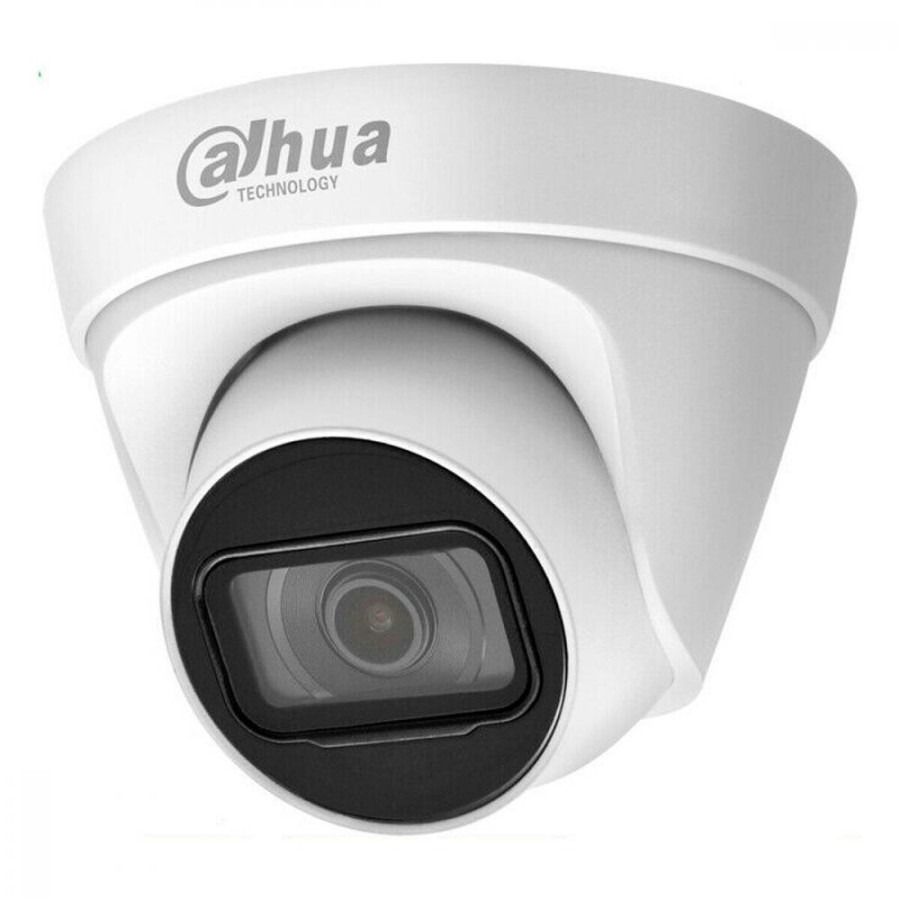
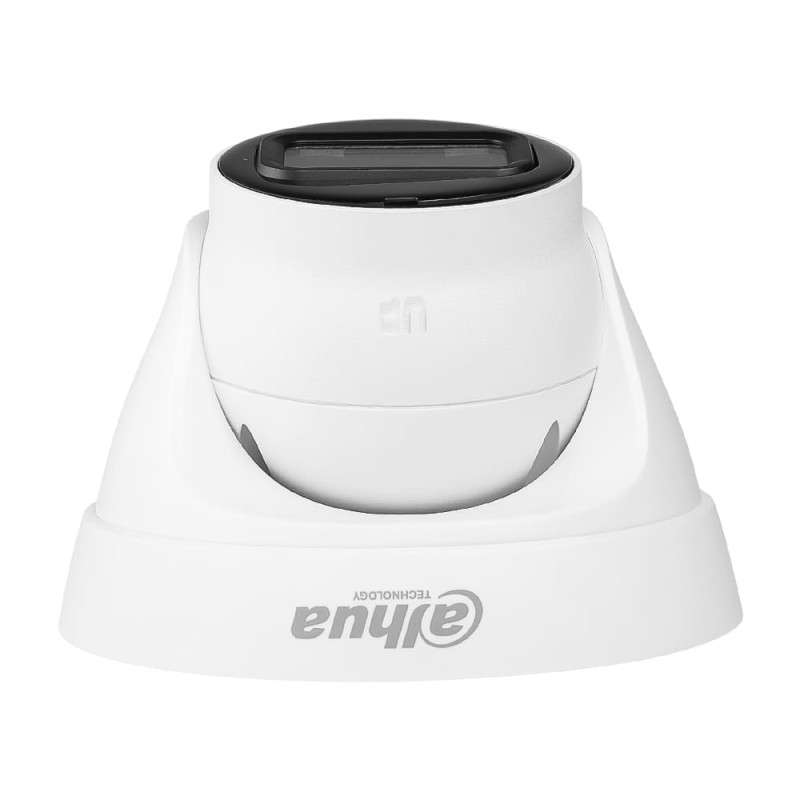
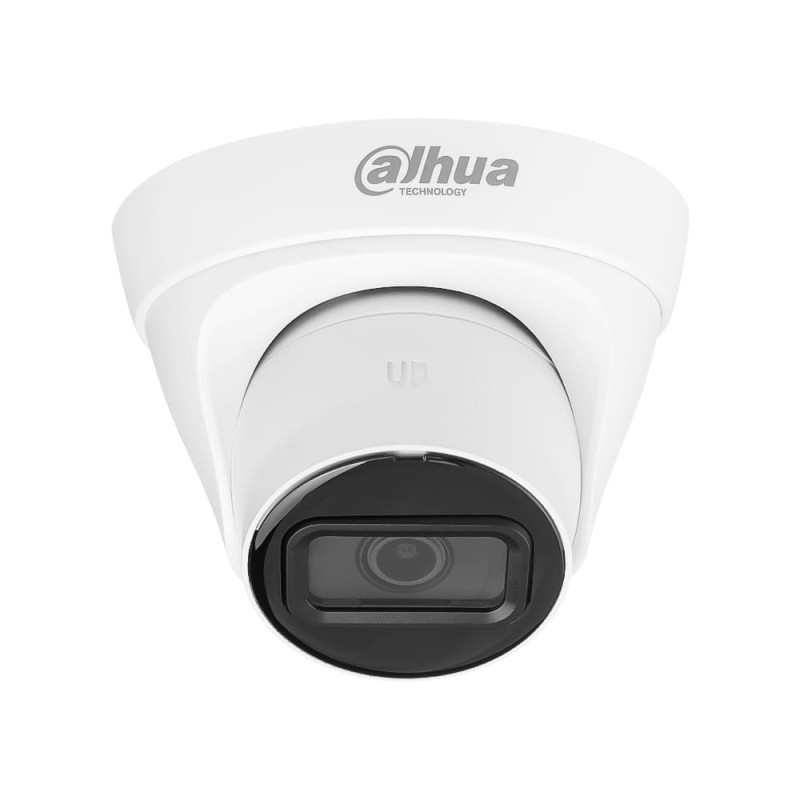
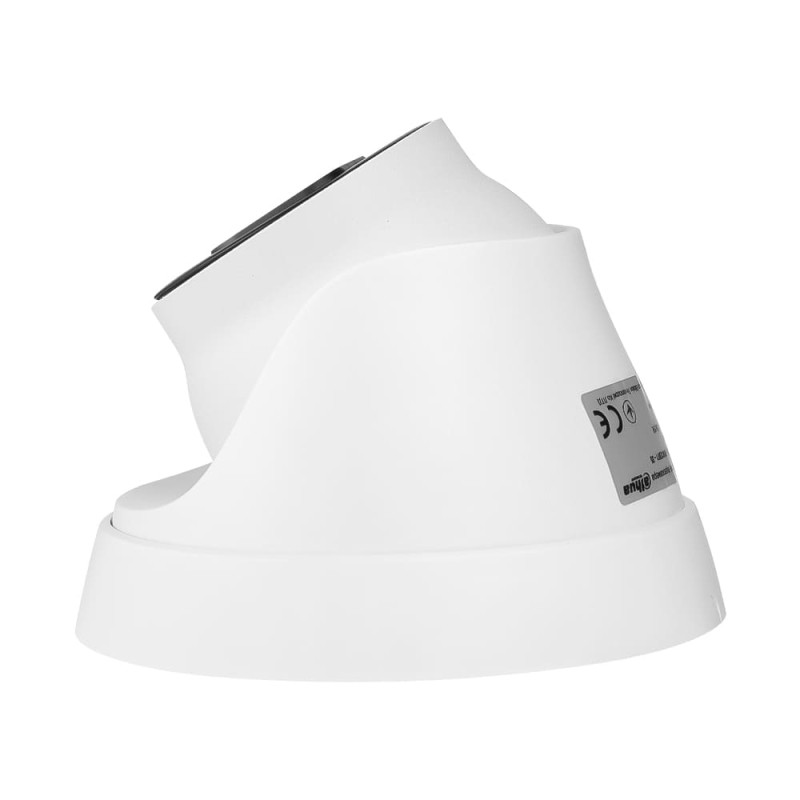
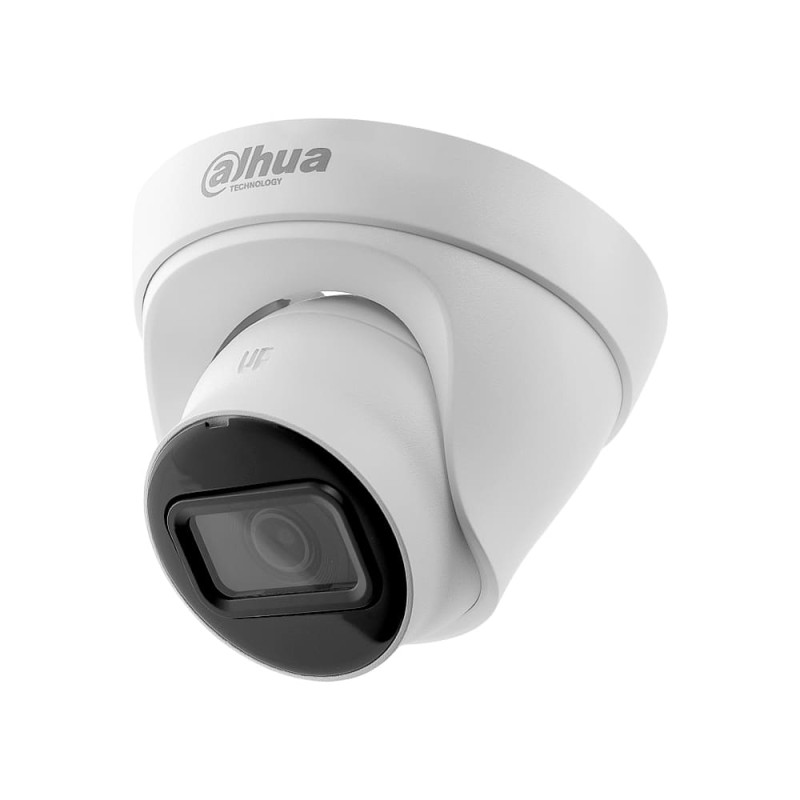
An eyeball body is a hemisphere seated in a ring, so once the base is fixed you rotate the ball freely and lock it on the exact doorway or path you care about, with no extra bracket involved. The unit stands 85.5 mm tall on a 109 mm diameter base and weighs 240 grams, which means ordinary wall plugs hold it on a wall or ceiling without reinforcement. IP67 sealing and an operating range of -40 to +60 °C cover both a hard winter and a roof soffit baking in July, and the construction combines a metal inner core with a plastic shell and trim ring. The drawback of the hemispherical shape is optical: the transparent dome collects dust, spider webs and droplets, and the moment a web is spun in front of the glass the infrared light bounces straight back and washes the whole frame out. For that reason an eyeball should not sit flush against a wall or deep under a narrow eave — leave at least ten centimetres of clearance, or reflected IR will flare the edge of the image and the dome will need wiping every month.
Power, network and bandwidth: what to budget for in the wider system
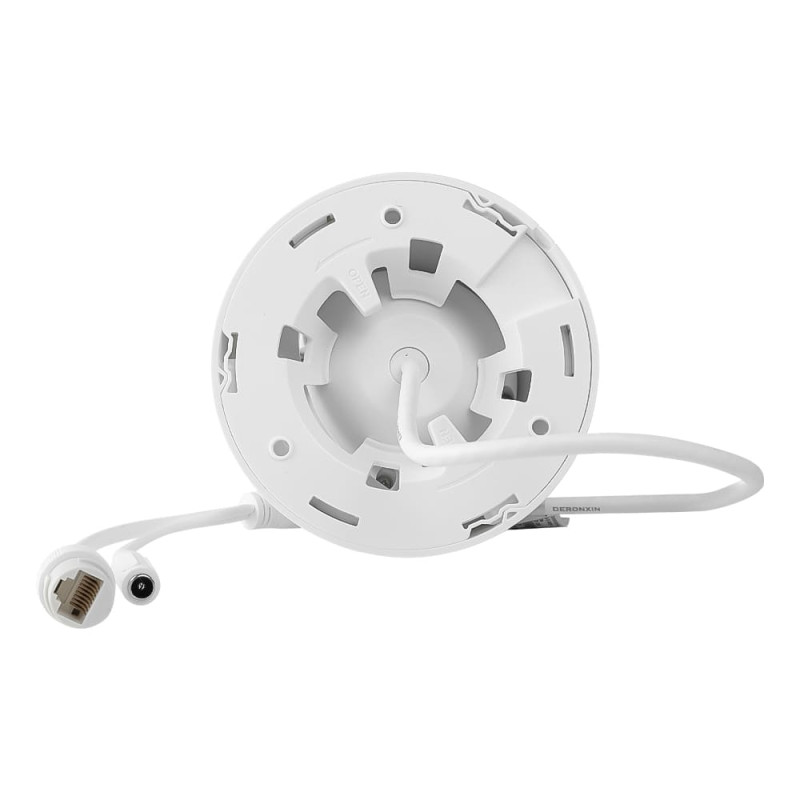
The camera runs either from a 12 V adapter or over PoE 802.3af on the same cable that carries the video, and it is frugal: around 1.4 W in the basic 12 V mode and up to 4.3 W at peak with the infrared emitter and H.265 both working. Practically, even an entry-level eight-port PoE switch with a 60-65 W budget carries eight of these cameras with room to spare, and on long cable runs that low draw is exactly what saves you from voltage sag at the far end. The network port is 100 Mbit, which is ample for a 2-4 Mbit/s stream; the ceiling only shows up when several people pull archive footage at once, as the camera officially supports six simultaneous connections. Smart H.265+ with variable bit rate roughly halves the data of H.264 at comparable quality, so in real conditions one camera consumes about 25-35 GB per day recording continuously, and a 2 TB disk holds roughly two months of four-camera footage. Switch to motion-triggered recording and the same disk stretches to half a year — provided detection zones are drawn properly, otherwise one windy night will record everything anyway.
No storage on board: the camera depends entirely on the recorder
This variant has no memory card slot; the only edge storage option it offers is FTP, so the entire archive lives on an NVR, a NAS or a server. The consequence deserves thought before purchase: if the link between camera and recorder drops, or the recorder loses power along with the rest of the house, the recording has a hole for exactly that period and nothing can fill it in, unlike cameras with an SD card that buffer locally and upload the gap later. Two practical conclusions follow — keep the recorder and the switch on a UPS, and power the camera over PoE from that same UPS so the whole chain goes down and comes back as one unit. Compatibility is broad in exchange: ONVIF Profile S and Profile T, RTSP, CGI and P2P are all supported, so the camera joins a third-party NVR or a VMS such as Genetec as readily as a Dahua recorder, and its RTSP stream drops neatly into a home server running Frigate or Home Assistant. The vendor route is simple too, with the DMSS mobile app and desktop Smart PSS reaching the camera through P2P without port forwarding or a static IP.
Where this camera belongs, and where it has no business being
This is a close-range workhorse: a porch and front door, a hallway or entrance lobby, the till area of a small shop, a parking spot right beside the house, a stockroom with a few racks. Anywhere the point of interest sits within five to seven metres, 2 MP produces footage that is genuinely usable, and the 102° angle lets one camera replace two in a small room. Indoors the rounded body also reads as less aggressive than a bullet on a bracket, which is why eyeballs dominate retail floors and offices where customers should not feel watched by a gun-shaped device. What you should not ask of it: reading number plates at an entrance gate, covering a 40-50 metre fence line, delivering colour identifying details after dark, or producing alerts precise enough to act on. Every one of those jobs has a proper answer elsewhere in this catalogue — varifocal optics, dual illumination, on-board AI — and forcing this model into them guarantees a system nobody ends up using.
How it differs from its neighbours in this catalogue
Its closest relative is the Dahua DH-IPC-HDW1431T1: identical housing, identical 2.8 mm optics, the same absence of AI, but a 4 MP sensor instead of 2 MP, which puts roughly twice as many pixels across the same field and noticeably extends the distance at which recognition still works. If the camera looks further than five metres, paying extra for 4 MP repays itself immediately; if it watches a lobby or a checkout at arm's length, you will not see the difference and the smaller sensor spends the budget more honestly. The Dahua DH-IPC-HFW1230S1 is essentially this same package in a bullet body — same resolution, same 30 metres of IR — but a bullet is visible from a distance and deters by itself, mounts more easily on a pole and collects no cobwebs in front of the glass, while being easier for an intruder to twist aside. The DH-IPC-HDW1239T1-LED shares the form factor but swaps infrared for permanent white light and therefore yields colour at night, which is right where identifying details matter and wrong wherever a lamp burning all night would annoy the neighbours. If accurate alerts are the real requirement, look at the DH-IPC-HDW2249T-S-IL with human and vehicle classification plus dual illumination; and if the task is an entrance gate, the varifocal DH-IPC-HDW1230T1-ZS-S5 with 2.8-12 mm optics and 40 metres of IR lets you dial the angle and reach to that specific spot.
Tell us which point you need covered and how far it sits from the mounting position, and we will work out whether 2 MP is genuinely enough in your case and match a recorder with spare capacity for the archive.
Characteristics Dahua HDW1230T1
Reviews about Dahua HDW1230T1 from real users
No reviews found







