
 m. Сміла, Незалежності, 67г. оф, 406/6























DAHUA DH-IPC-HDBW3441E-AS-S2 (4 MP/2.8 MM) - DOME PoE IP CAMERA

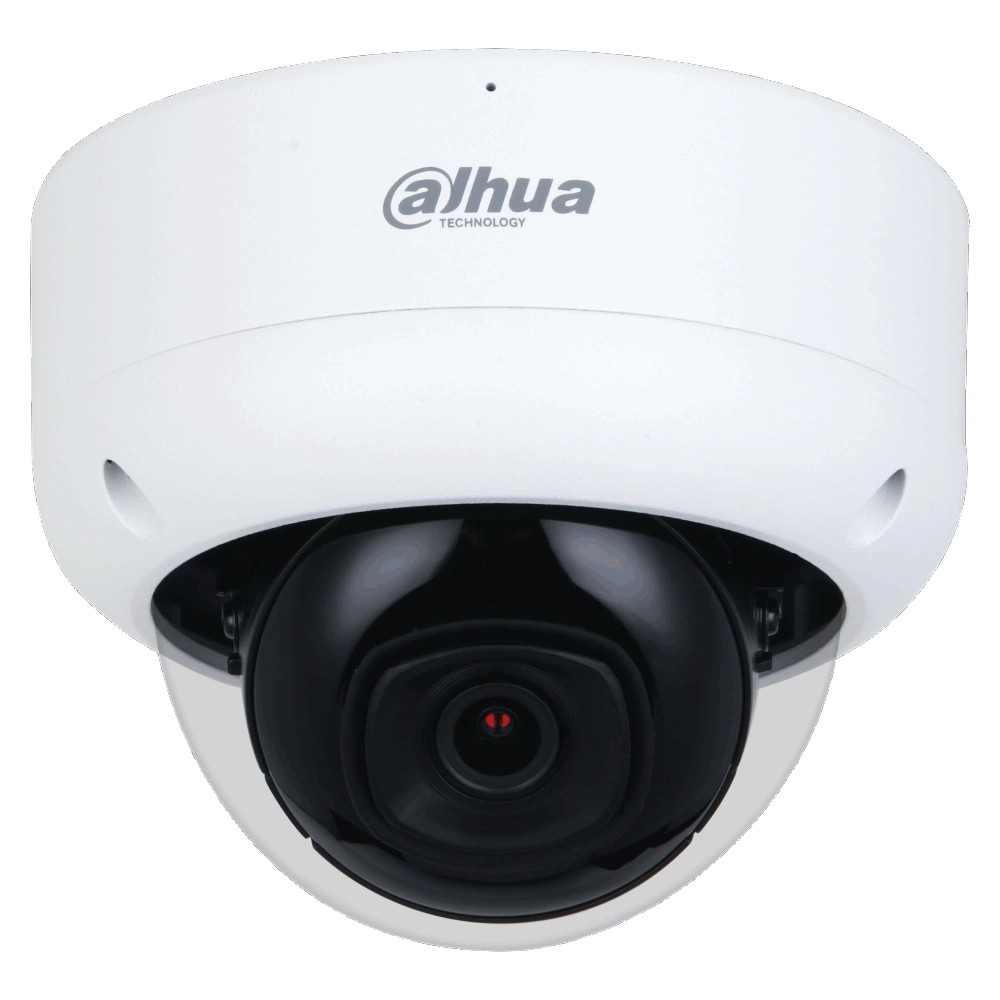


Description Dahua HDBW3441E-AS-S2
HDBW vandal-resistant dome: a housing built to take a hit
The HDBW prefix in Dahua's model code specifically denotes a vandal-resistant dome, and the difference is measurable rather than cosmetic: the housing carries an IK10 rating, which means it survives at least five strikes from a 5 kg hammer dropped from 40 cm, an impact energy of 20 J. A metal shell 111.7 mm across and 89.1 mm high, weighing 516 g, sits flush against the ceiling or wall, so there is no protruding arm to grab, twist or loop a rope around. IP67 protection covers full dust tightness and half an hour under a metre of water, while the operating range from -40 °C to +60 °C handles both a January night and a south-facing warehouse wall in July. In practice this is the camera for places a person can physically reach: apartment entrances, school corridors, underground parking, filling stations, loading docks and service bays. The dome form does bring one chore, though — the clear bubble gathers dust and cobwebs, the infrared LEDs then light up that film and add a milky veil to night footage, so plan on wiping it once a season; bullet housings with recessed front glass stay clean noticeably longer.
WizSense and SMD 4.0: the camera tells a person from a shadow on its own
Classification runs on a dedicated Dahua WizSense AI chip inside the camera, so it depends neither on the recorder model nor on a cloud subscription. SMD 4.0 does more than register changed pixels: it decides what is moving and deliberately discards small and large animals, swaying branches, shadows and reflections on wet asphalt, which between them account for most false alarms on an ordinary camera. On top of that sits Perimeter Protection with tripwire and intrusion rules that carry their own human and vehicle classification, so you can be alerted when somebody climbs over the line drawn along the fence while cars passing through the neighbouring zone stay silent. Paired with an AI NVR from Dahua the Quick Pick function becomes available: you search the archive by object type instead of by timestamp, and eight hours of night recording collapse into a one-minute review of every human appearance. One limit is worth knowing before you buy — animals here are what the algorithm is trained to ignore, not a separate alert category, so the task «tell me when a stray dog walks into the yard» is not what this model solves.
Night vision: a sensitive sensor plus fifty metres of infrared
The 1/2.9" 4 MP sensor delivering 2688 × 1520 at 25 fps is physically larger than the 1/3" chips used in Dahua's entry series, and together with the fast F1.4 lens it yields a rated sensitivity of 0.005 lux in colour and 0.0005 lux in black and white. On site that translates into a picture that stays in colour well past the point where your own eye sees only outlines, and a camera that does not flip to infrared at the first dusk shadow. The illuminator itself reaches 50 metres, double the 30 metres typical of the budget segment and unusual for a dome, but note what the model code does not contain: there is no -IL suffix and no white LEDs, so night footage is monochrome. That matters during an investigation — you will see that the person wore a dark jacket, not that the jacket was red and the car silver, and when colour at night is essential the catalogue has Dahua models with the -IL index and Smart Dual Light. In return you get 120 dB WDR and HLC, which rescue the classic driveway scene where a car on high beam turns into a dark yard and would otherwise leave a white blob instead of a number plate, plus AI SSA that adapts the image to rain, fog and backlight without anyone touching the settings.
A 2.8 mm lens and the honest DORI numbers
The fixed 2.8 mm lens gives 107° horizontally and 127° diagonally, a wide view that swallows a room, a lobby, a till area or a small yard in one frame. Dahua publishes DORI figures for exactly this focal length: detection 63.6 m, observation 25.4 m, recognition 12.7 m, identification 6.4 m. Read them literally — you can expect to identify a specific face on the recording out to roughly six metres, and beyond that you will only be able to say that someone in a light jacket walked past. This is why a wide-angle camera belongs above a passage point such as a doorway, a turnstile, a till or a staircase, rather than in a far corner chosen so that it «sees everything»: across a large area it gives you an account of events but not evidence. The same body also ships with 3.6 mm optics, which identify out to 8.5 m at 88°, and with 6 mm, good to 12.4 m at 54°, so for a face at a gate ten metres away the right move is narrower glass rather than digital zoom; the 0.7 m close focus distance of the 2.8 mm version means nothing goes soft even directly beneath a ceiling of 2.5 to 3 metres.
The -AS ports, PoE power and a standalone archive
The -AS index means the camera has an alarm input and output plus audio in and out on RCA connectors, while the -S-S2 version lacks all four, so paying the premium for them should be a deliberate decision. An alarm input is a door contact, an infrared beam or a button that makes the camera start recording before anybody enters the frame, and the 300 mA 12 V output drives a relay, a siren or a lamp. The audio output lets you hook up an active speaker for a spoken warning, and the built-in microphone records sound inside the camera itself, which often settles a dispute, bearing in mind that audio recording in public spaces carries legal constraints. Power arrives over PoE 802.3af at roughly 3.5 W idle and up to 8.3 W with the illuminator, WDR and analytics all running, or over 12 V DC with a generous ±30% tolerance that rescues long cable runs and sagging supplies. A Micro SD card up to 256 GB together with FTP, SFTP and NAS recording provides a fallback archive for the case where the recorder is switched off or carried away, while ONVIF Profile S/G/T, CGI and Milestone and Genetec support let the camera join a third-party system — with the caveat that Quick Pick and part of the AI event set work only alongside a Dahua recorder.
Where this camera belongs and what it is built for
The model is at its best where two conditions meet: the camera is within arm's reach, and what you need is not merely footage but filtered alarms somebody will actually act on. That describes apartment entrances and lift lobbies, school and dormitory corridors, a sales floor and the till area, a warehouse with a loading dock, parking decks, service stations and fuel stations — places where IK10 metal earns its keep and 107° covers a whole room from a single point. Outdoors it works too thanks to IP67 and the -40 °C rating, with two reservations: night footage is monochrome, and the bubble needs wiping after a season of rain and dust. Two jobs are better handed to a different camera, namely reading plates at a gate, which calls for narrower optics and separate shutter settings, and watching a large open perimeter from one point, where 6.4 metres of reliable identification changes nothing. In the layout of one camera per passage, however, it is close to ideal: a recognisable face at three to six metres, long reach at night, and an alarm input that ties the recording to the moment a door opens.
How it compares with its neighbours in this catalogue
The closest relative is the DH-IPC-HDW3441EM-S-S2: the same third-series WizSense platform and the same 50-metre illuminator, but in an eye-ball housing with no vandal resistance and no alarm or audio ports, which makes it the more sensible pick for a room where nobody will touch the camera. The junior DH-IPC-HDBW1431EP-S4 looks similar and also offers 4 MP, yet it belongs to the first series with no AI analytics and a 30-metre illuminator: it alerts on any movement, owners usually switch those notifications off within a week, but if the camera exists purely so that you can review footage after the fact it is enough. When colour at night is the deciding factor, look at HDBW2449E-S-IL or HDBW2449F-AS-IL, which are 4 MP second-series domes with Smart Dual Light and colour night video, paid for with a shorter 30-metre illuminator and a lens slower than F1.4. For more detail in the same format there is the 8 MP HDBW2849E-S-IL: more pixels across the same angle, at the cost of archive size and weaker low-light behaviour, because each individual pixel is physically smaller. The summary is simple — HDBW3441E-AS-S2 makes sense when you need the vandal-proof housing, full WizSense human and vehicle classification and the alarm ports all at once; if any one of those three is not critical, the catalogue holds a simpler alternative.
If you are unsure which focal length suits your passage or your room, send us the dimensions of the area and the mounting height. We will work out what actually fits in the frame and at what distance a face stays recognisable.
Characteristics Dahua HDBW3441E-AS-S2
Reviews about Dahua HDBW3441E-AS-S2 from real users
No reviews found







