
 m. Сміла, Незалежності, 67г. оф, 406/6























DAHUA DH-IPC-HDBW2449E-S-IL (4 MP/2.8 MM) - DOME PoE IP CAMERA

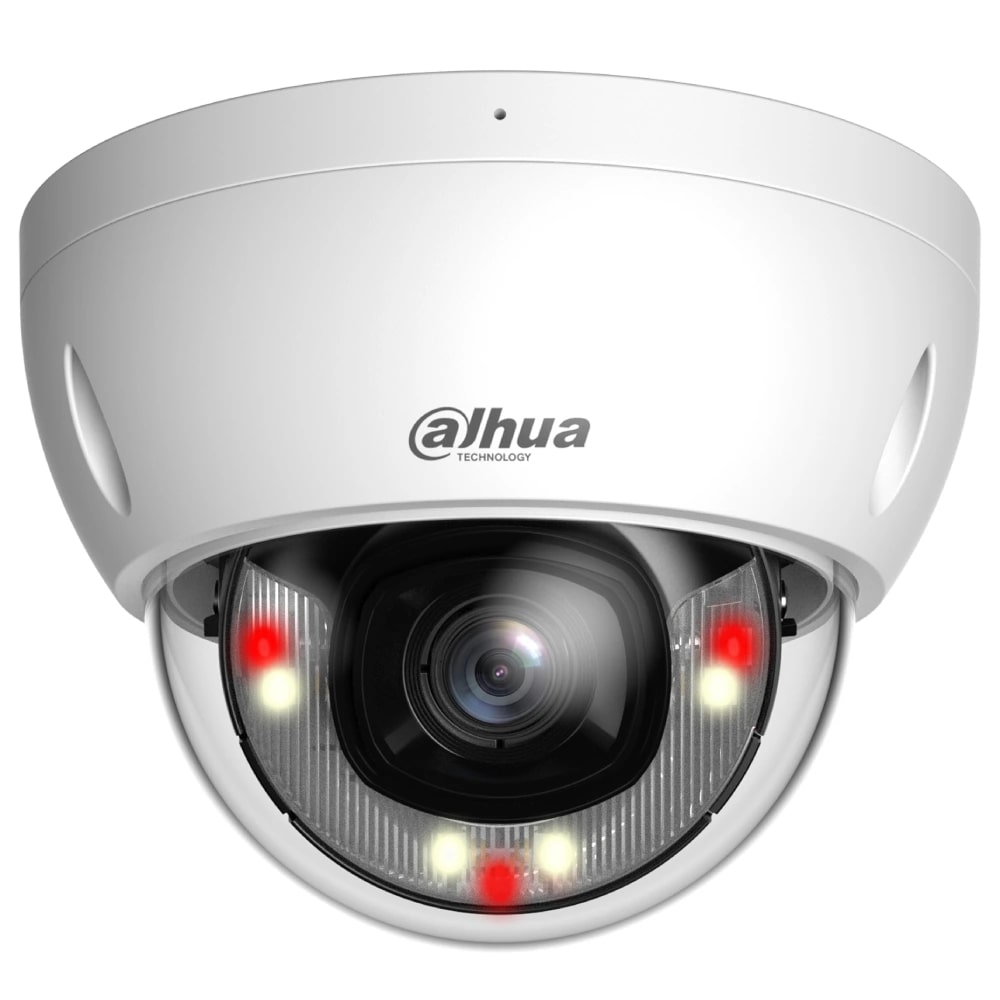
Description Dahua HDBW2449E-S-IL
Smart Dual Light: two illuminators that switch on target recognition
The -IL suffix stands for Smart Dual Light: the dome holds four multi-core LEDs that combine infrared and warm-white dies, and the camera decides on its own which of them to fire. In its resting state the invisible IR illuminator works out to 30 metres — neighbours see no light, moths do not gather at the lens, and the picture is monochrome. The moment the analytics identify a person or a vehicle in the scene, the warm white light comes on, also rated to 30 metres, and the camera switches to full-colour recording of precisely the fragment that matters. When an event is reviewed the difference is decisive: an IR frame shows a figure in a dark jacket, a colour frame shows that the jacket is blue and the car at the gate is a red hatchback — descriptions you can actually hand to the police. Once the person leaves the zone the white light goes out and IR returns, so the camera does not floodlight windows all night and does not create the light pollution that neighbours usually complain about after a new system goes in.
4 MP, an F1.6 aperture and 0.006 lux: how much is visible before the light fires
The 1/2.9" sensor outputs up to 2688×1520, and together with the unusually fast F1.6 lens it reaches a colour sensitivity of 0.006 lux — the level at which the camera still holds colour from a street lamp forty metres away or from an illuminated shop sign, with no illumination of its own. At true darkness (0 lux) the LEDs take over and the Smart Dual Light logic described above comes into play. One technical nuance is worth knowing: the full 4 MP frame of 2688×1520 is delivered at 20 fps, while 25 or 30 fps are available in 2560×1440 — slightly tighter vertically but noticeably smoother. For an entrance hall or a gate where people walk through slowly the first mode makes more sense; for a driveway with cars passing the second one does, because 20 fps leaves more smeared frames on moving subjects. WDR at 120 dB, HLC and 3D noise reduction add exactly what a light-to-shadow boundary demands: a sunlit gateway and the dark passage beneath it are resolved in the same frame without either collapsing.
WizSense: tripwire and intrusion with human-versus-vehicle classification
The camera is built on the WizSense platform with a dedicated AI chip, so the analytics run inside the camera rather than on the recorder, and an object is classified before the event ever becomes an alarm. Two perimeter-protection scenarios are available — virtual tripwire crossing and area intrusion — and both distinguish a person from a vehicle, so you can alarm on someone climbing the fence while ignoring a car driving along the street inside the same frame. The second filtering layer is SMD Plus, which discards motion not caused by a target: branches in the wind, rain inside the illumination beam, a cat on the path, shadows thrown by passing traffic. The practical result is not another bullet point but a working security function — the owner receives a handful of meaningful alerts per night instead of a hundred empty ones, and therefore does not disable notifications after the first week. There is a useful side effect for the archive too: paired with a Smart NVR the camera supports searching by object type, which turns reviewing a night shift into a dozen clips instead of eight hours of footage.
A vandal-resistant dome: IP67, IK10 and metal instead of plastic
The HDBW designation means a vandal-resistant dome specifically: an all-metal body with a transparent bubble rated IK10, which withstands repeated impacts of 20 joules — a five-kilogram hammer dropped from forty centimetres. That is the main reason to choose this shape anywhere within arm's reach: a stairwell, an entrance archway, a sales floor, a car wash, a school corridor, places where a bullet camera on a bracket simply gets twisted towards the wall or knocked off with one blow. IP67 covers more than dust and rain; it certifies short full immersion, thirty minutes under a metre of water, which matters in practice during the kind of downpour that pushes water in under a cornice. The -40…+60 °C operating range and the ±30% wide-voltage tolerance are specified for genuine outdoor service: the camera restarts after a winter blackout and keeps working through sags in the supply. Mounting goes straight onto a wall or ceiling and aiming is done on three axes inside the bubble — the body stands only 81 mm tall on a 109.9 mm diameter and weighs 350 g, so the dome does not protrude as a target and needs no reinforced bracket.
PoE 802.3af power and how it adds up across several cameras
The camera runs either from an ordinary 12 V supply or over twisted pair via PoE 802.3af, and on site the second option is almost always the better one: a single cable carries both video and power, and during an outage you only need to back up the switch rather than every camera separately. The declared draw of 5.9 W is moderate even with the illuminator and analytics running, so eight of these domes amount to roughly 48 W of useful load, and a typical eight-port PoE switch with a 60-65 W budget covers the whole system without moving up to a more expensive model. If you power it locally from 12 V, remember voltage drop on long thin cable: for twenty to thirty metres plan on at least 0.75 mm² conductors, otherwise the camera will start rebooting at the exact moment the white light switches on and current peaks. The ±30% wide-voltage tolerance makes this model more forgiving of weak supplies and long runs than most budget cameras, but it does not repeal the arithmetic. The network port is 100 Mbps, which is ample for the two H.265 streams this camera produces.
Archive and compatibility: microSD up to 256 GB, ONVIF S/G/T and catalogue recorders
The camera takes a microSD card of up to 256 GB, which is not a substitute for a recorder but an insurance policy: if the cable is cut or the NVR goes down, the camera keeps recording locally and hands that fragment over afterwards. To size the main archive, use this rule of thumb: 4 MP in H.265 at moderate settings averages about 4 Mbps, which is roughly 43 GB per day from one camera recording continuously — on a 2 TB disk that is about forty-six days for a single camera or a little over a week for four. Switch the system to SMD Plus event recording and the same disk stretches three to five times further, so the on-board analytics save money directly on storage. The camera supports ONVIF profiles S, G and T plus CGI, FTP and SFTP, so it integrates not only with the Dahua recorders in this catalogue — the DHI-NVR1104HS-P-S3/H or DHI-NVR2104-P-I2 with built-in PoE, for instance — but with third-party NVRs and VMS platforms as well. Just keep in mind that ONVIF carries video and basic events into a foreign recorder, not the whole WizSense logic: the complete scenario set and smart search work in combination with a recorder of the same brand.
Where this camera belongs and the jobs it was designed for
A 101° horizontal field of view combined with 30 metres of illumination makes this a general-purpose mid-range overview camera: a private yard, an entrance group, office parking, a warehouse loading edge, a sales floor, the lobby of an apartment block. The official DORI figures for the 2.8 mm version are 63.6 m to detect, 25.4 m to observe, 12.7 m to recognise and 6.4 m to identify, which in practice means the camera registers the appearance of a person across the whole plot, but to identify a face you need to bring the point of passage — a gate, a door, a till — inside six or seven metres. The vandal-resistant dome earns its keep wherever the camera hangs within three metres and can be reached: stairwells, archways, entrance gates, car washes, cafés. Where this model is out of place is on a long narrow site: covering sixty to eighty metres of fence, or a driveway where plates must be legible, calls for tighter 3.6 mm optics and a bullet housing with fifty-metre illumination. It is also the wrong choice as the single camera of a large warehouse — 101° will cover the area, but detail at the far end of the bay will be overview-grade rather than identification-grade.
How it differs from the neighbouring models in this catalogue
The direct relative is the Dahua DH-IPC-HDBW2449F-AS-IL: the same sensor, the same optics and the same dual illumination, but in a fuller configuration — with RCA audio input and output and an alarm input and output, meaning an external microphone, loudspeaker or siren can be wired in. If those terminals are not needed, the E-S version gives the identical picture without paying for connectors you will never use; if public address or a link to an alarm panel is planned, take the F-AS. The Dahua DH-IPC-HDBW2849E-S-IL is the same housing with the same Smart Dual Light logic but 8 MP instead of 4 MP: the upgrade pays off when you intend to zoom digitally into a fragment of a wide frame, and does not when the archive is reviewed on a 1080p monitor anyway. The DH-IPC-HDW2449T-S-IL is effectively this camera in an eyeball housing — cheaper and faster to install, but without the IK10 metal bubble, so it belongs at heights where nobody can reach it. And if analytics and colour night vision are not needed at all, the catalogue holds the DH-IPC-HDBW1431EP-S4: the same 4 MP vandal dome format with classic IR and motion detection only — for a stairwell where you simply need to see that someone walked through, it is honestly enough.
Send us the layout of your site — perimeter length, number of entrances and mounting height — and we will match the focal length, the number of cameras and a recorder with headroom for the archive depth you need.
Characteristics Dahua HDBW2449E-S-IL
Reviews about Dahua HDBW2449E-S-IL from real users
No reviews found







